
The Mariana Trench: Life in Earth's Deepest Abyss
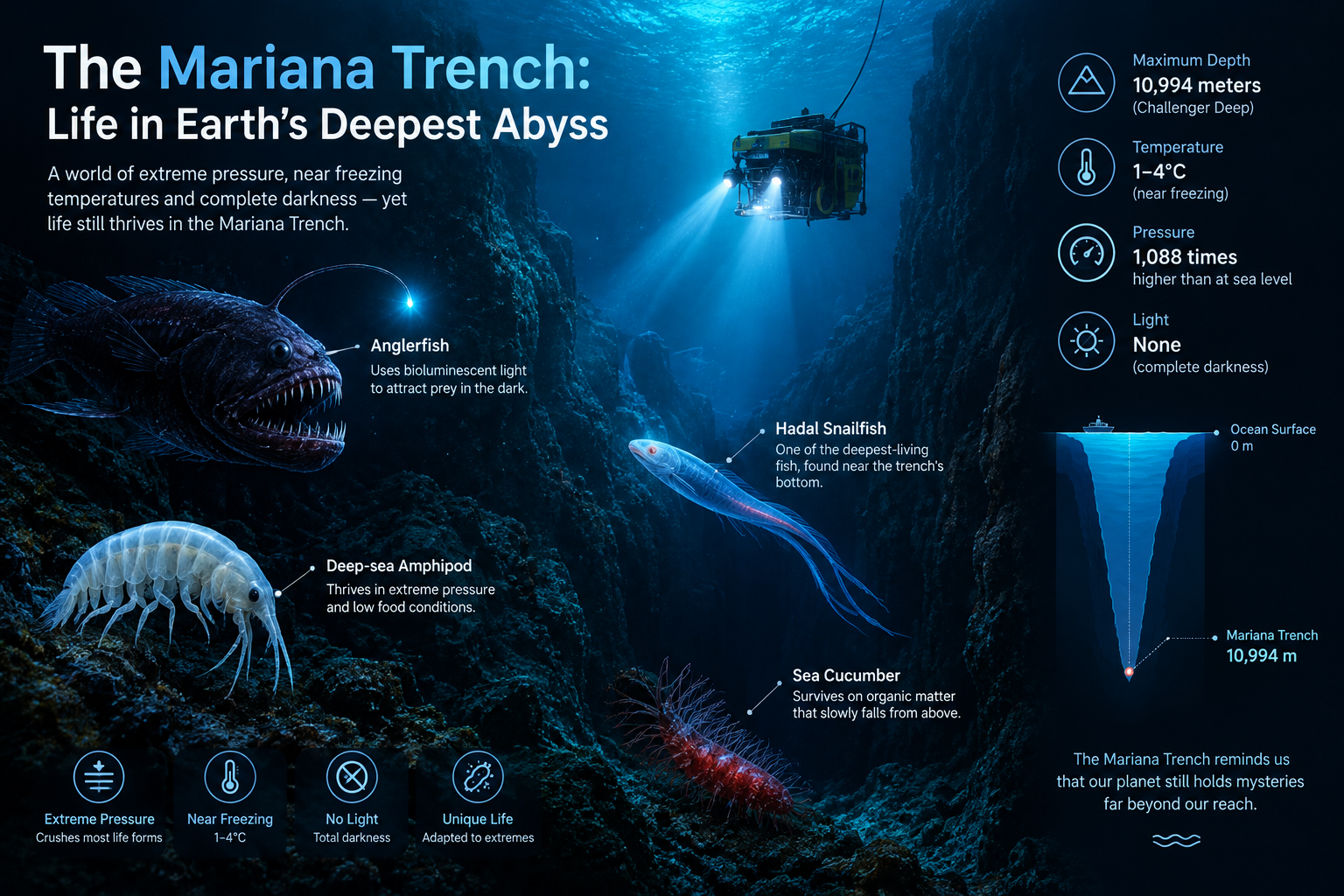
The Mariana Trench, located in the western Pacific Ocean, plunges to a depth of nearly 11,000 meters at its deepest point — the Challenger Deep. Here, in perpetual darkness and under crushing pressure 1,000 times that of the surface, life not only exists but thrives.
Extreme Survivors
Scientists have discovered a remarkable array of organisms adapted to these extreme conditions, including giant single-celled organisms called xenophyophores, translucent sea cucumbers, and shrimp-like amphipods that have evolved unique pressure-resistant proteins.
Perhaps most fascinating are the microorganisms found in the sediment at the bottom of the trench, which survive by metabolizing chemicals rather than relying on photosynthesis — a process known as chemosynthesis.
Exploration Milestones
Only three expeditions have reached the bottom of the Challenger Deep: the bathyscaphe Trieste in 1960, James Cameron's solo dive in 2012, and Victor Vescovo's expedition in 2019.
Discussion 0
Leave a CommentNo comments yet
Be the first to share your thoughts on this story!
Leave a Comment
Join the conversation and share your insights.