
The Incredible Journey of a Butterfly
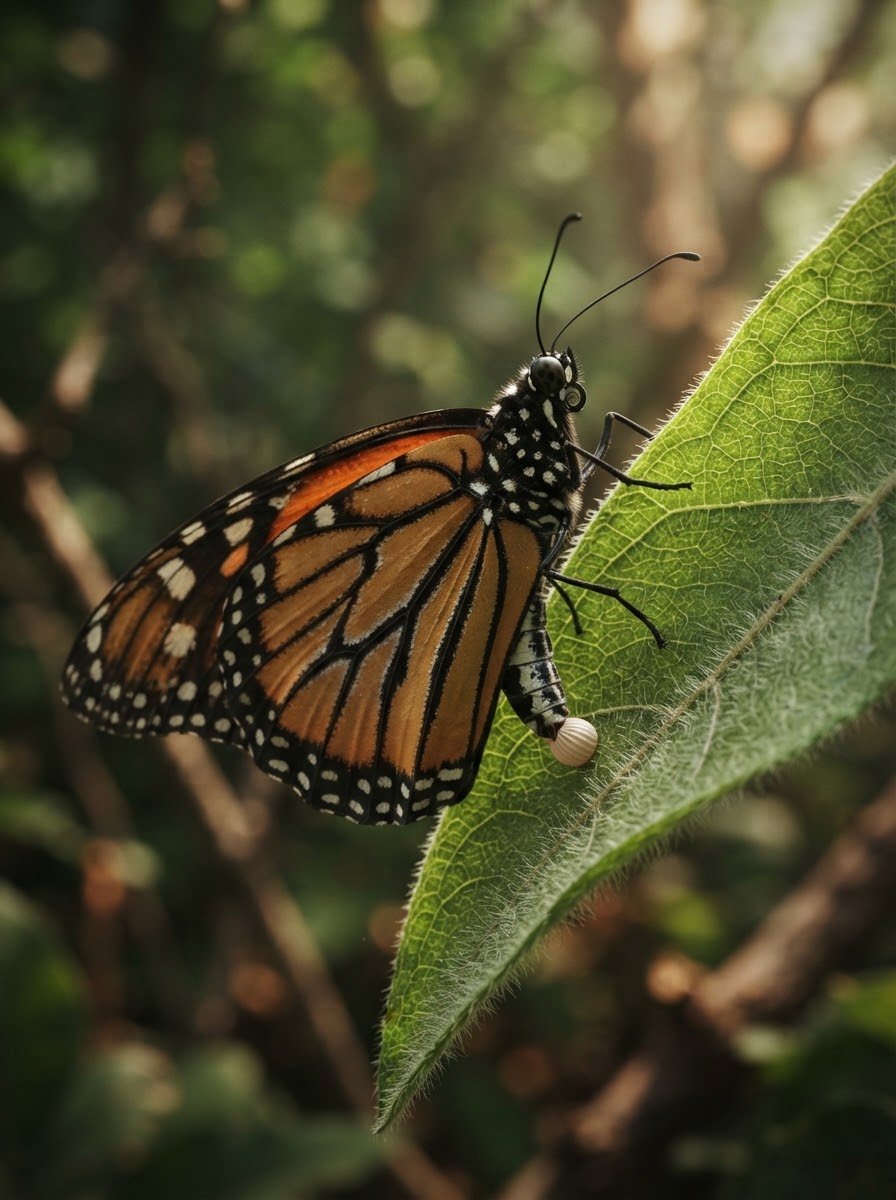
Overview & Species Guide Story Overview: Enter the hidden world of the Monarch butterfly (Danaus plexippus), a creature of delicate beauty and astounding scientific complexity. This journey follows a single life from a microscopic speck to a master of the skies. Chapter 1: The Sovereign of Summer. High above a sun-drenched meadow, a female Monarch searches for the only plant her future offspring can eat: milkweed. Chapter 2: A Tiny Sentinel. She lands with precision, curling her abdomen to glue a single, cream-colored egg to the underside of a leaf. This ridged, dome-shaped fortress is smaller than a pinhead but contains the blueprints for a transformation that defies imagination. Nature Fact: 1. Monarchs are "specialists," meaning their larvae can only survive on plants in the Asclepias (milkweed) genus. 2. A single female can lay up to 500 eggs over several weeks.
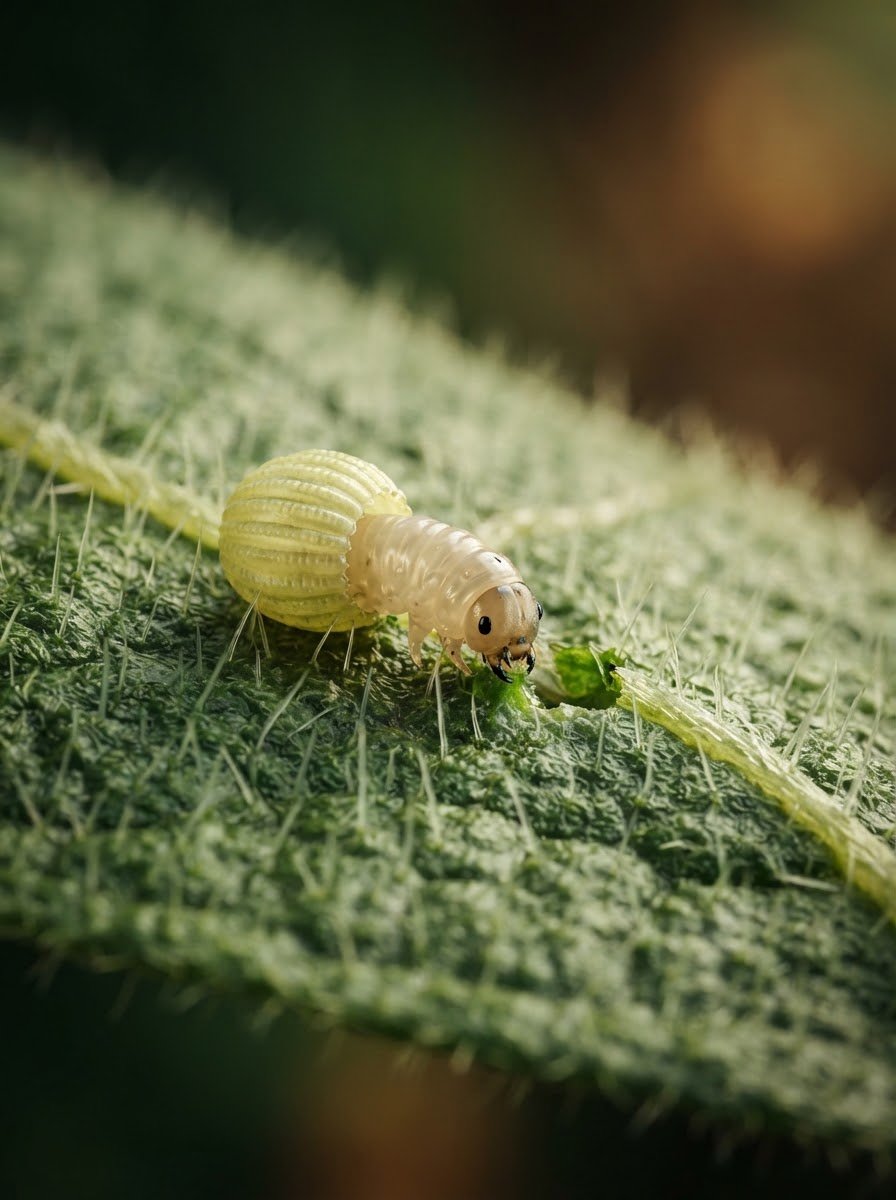
Chapter 3: The First Breath & Chapter 4: The Green Feast. Inside the egg, a tiny heart begins to beat. After four days, the shell becomes translucent, revealing dark mandibles within. The larva chews a circular hole and pushes its way into the world. Its first act is a lesson in efficiency: it turns around and consumes its own protein-rich eggshell. Now, it faces the milkweed. The plant fights back with "latex," a sticky, toxic sap, but the larva is prepared. It nips the leaf's veins to drain the pressure before beginning to feast. Nature Fact: 1. The first meal (the eggshell) provides essential nutrients for the larva's immediate growth. 2. At this stage, the larva is called a "first instar" and is only about 2 to 6 millimeters long.
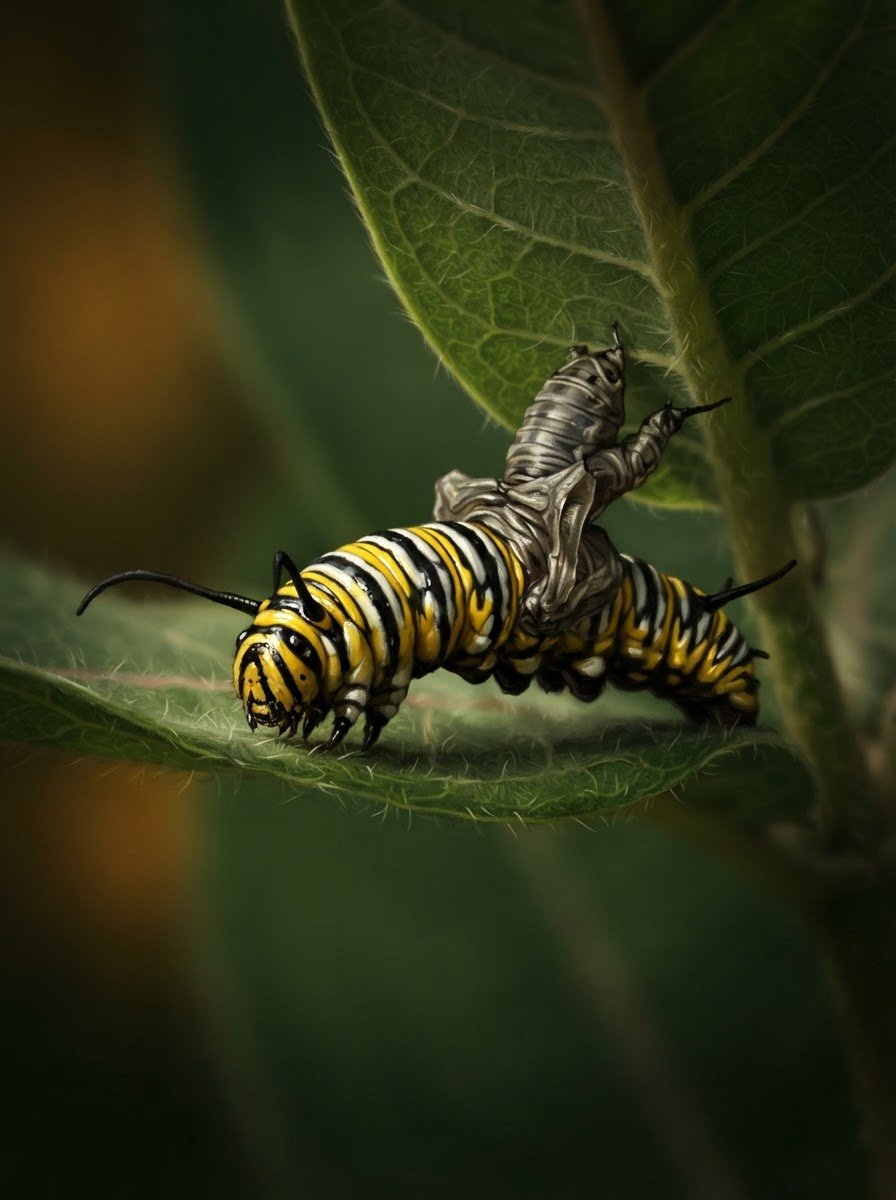
Chapter 5: Expansion & Shedding & Chapter 6: The Growing Giant. The larva is a biological eating machine. Its skin, made of chitin, does not stretch. To grow, it must molt. It spins a small silk mat, anchors itself, and remains still for hours. Then, the old skin splits behind the head. The larva crawls out in a brand-new, larger suit. Over two weeks, it repeats this process five times, transitioning through five "instars." By the final stage, it has grown nearly 2,000 times its original mass, sporting bold yellow, black, and white warning stripes. Nature Fact: 1. If a human baby grew at the same rate as a Monarch larva, it would weigh as much as an elephant in just two weeks. 2. "Instar" refers to the developmental stage of an arthropod between each molt.
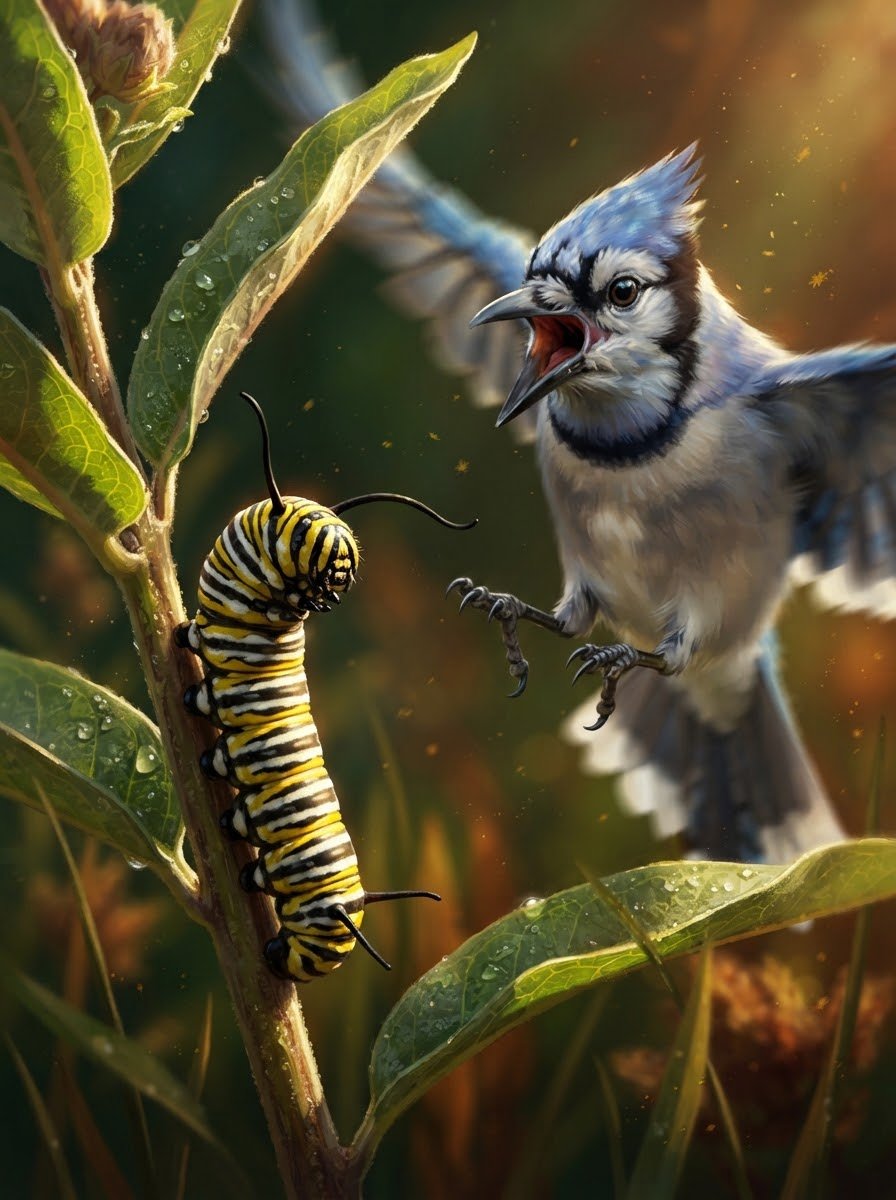
Chapter 7: Poison in the Veins. The larva’s stripes are not just for show; they are a visual "no-entry" sign. As it eats, it sequesters "cardenolides"—toxic chemicals from the milkweed—into its own tissues. Suddenly, a hungry Blue Jay swoops down. It lunges for the caterpillar, but the larva remains calm. One taste of the bitter, toxic chemicals is enough. The bird recoils, gagging. It will remember those stripes and never attack a Monarch again. The larva’s chemistry is its ultimate shield. Nature Fact: 1. Cardenolides are "cardiac glycosides" that can cause heart failure in many animals, but Monarchs have evolved a genetic mutation that makes them immune. 2. This defensive strategy is called "aposematism"—using bright colors to warn predators of toxicity.
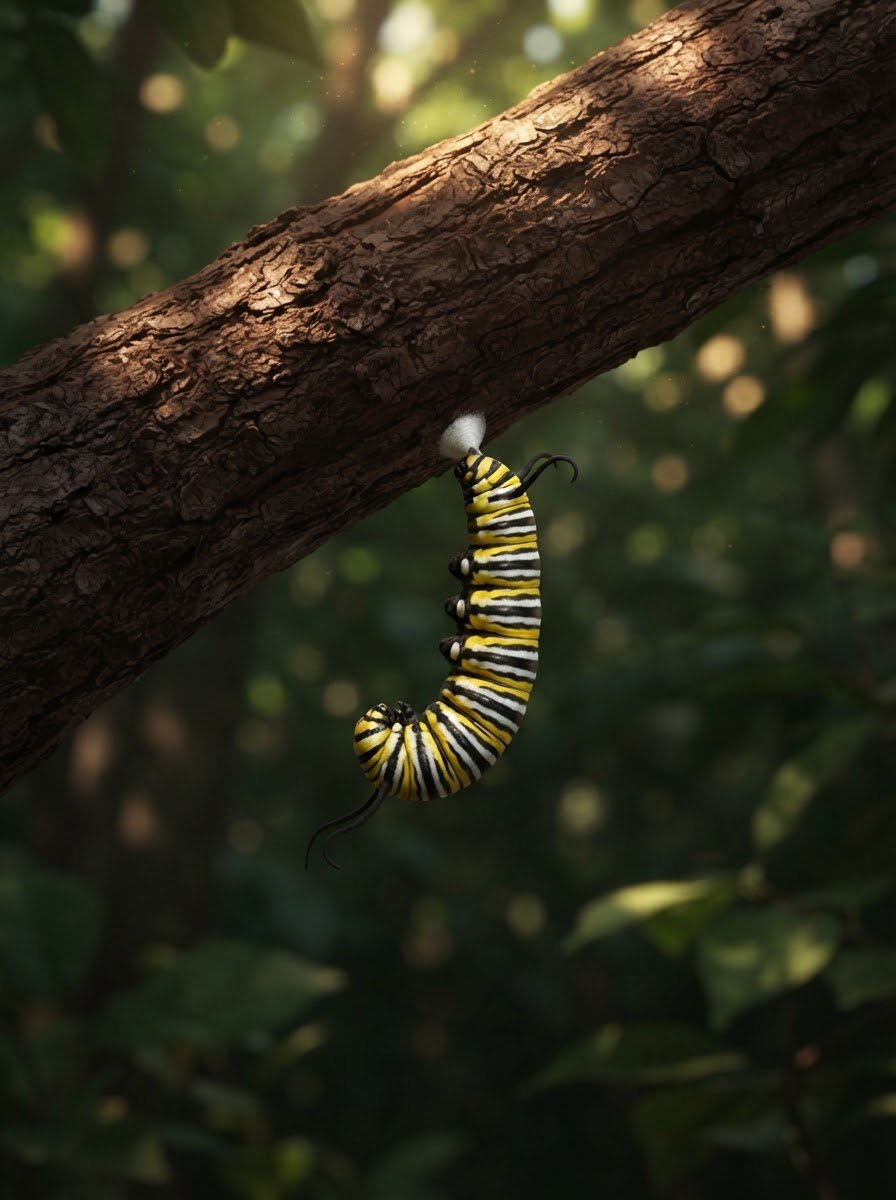
Chapter 8: The Great Wanderer & Chapter 9: The Anchor Point. Satiated and heavy, the larva stops eating. It feels a new instinct: the urge to climb. It leaves the milkweed, traveling several yards to find a sturdy branch or a garden fence. Once settled, it spins a dense "silk button" from a spinneret near its mouth. It hooks its rear legs into the silk and lets go, dropping into a perfect "J" shape. Its internal organs are already beginning to liquefy; the larva is preparing for its final act as a crawler. Nature Fact: 1. The wandering phase allows the larva to find a pupation site hidden from the predators that frequent the host plant. 2. The silk produced by the caterpillar is incredibly strong, capable of holding many times its body weight.
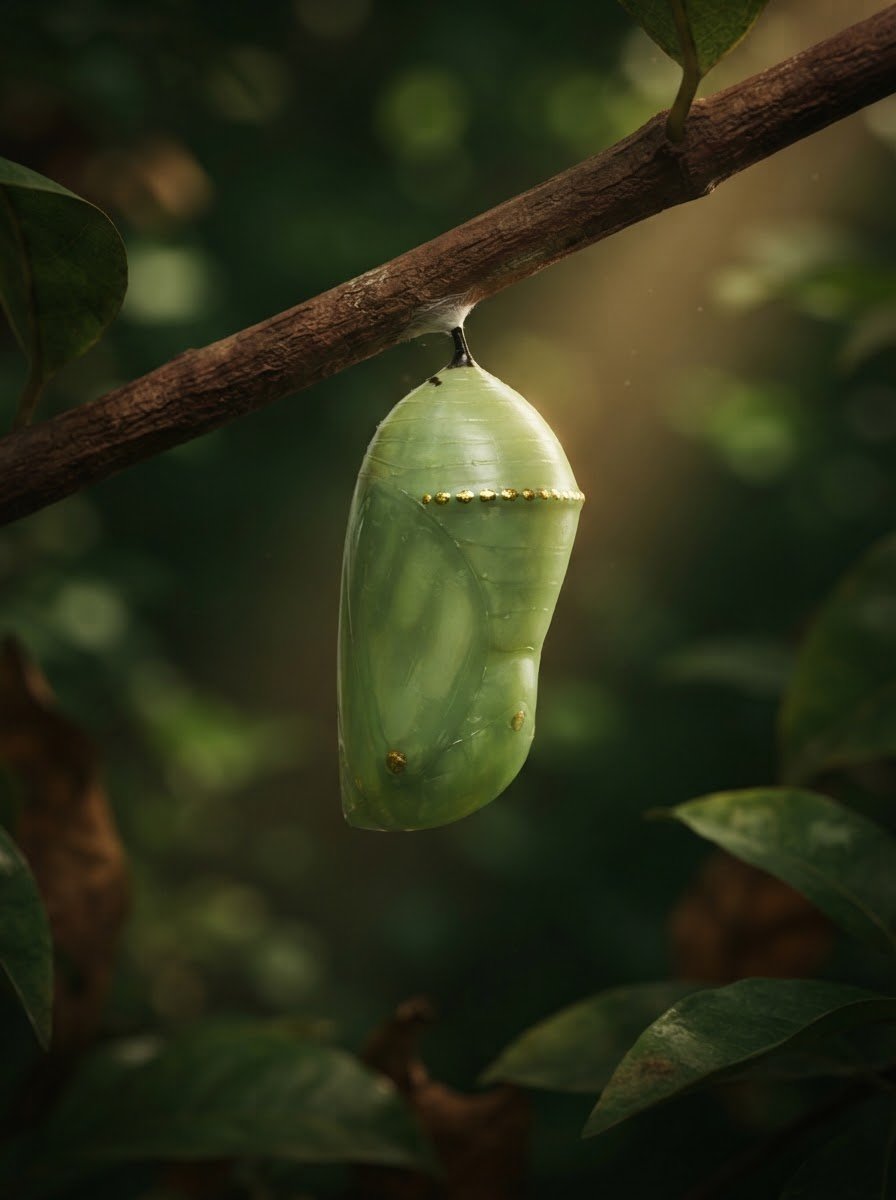
Chapter 10: The Emerald Armor. The transformation is violent and swift. The larval skin splits one last time, revealing a soft, lime-green form beneath. Through rhythmic pulsing, the larva sheds the striped skin completely. A hard, protective shell—the chrysalis—hardens around it. This is not a resting stage; it is a metabolic furnace. Inside, "imaginal discs"—clusters of cells that have been dormant since the egg stage—begin to build legs, wings, and complex eyes from the nutrient-rich soup of the dissolved larva. Nature Fact: 1. The gold spots on a Monarch chrysalis are not just decorative; they may help with oxygen intake or act as a form of camouflage. 2. A butterfly pupa is called a "chrysalis," while a moth pupa is often enclosed in a silk "cocoon."
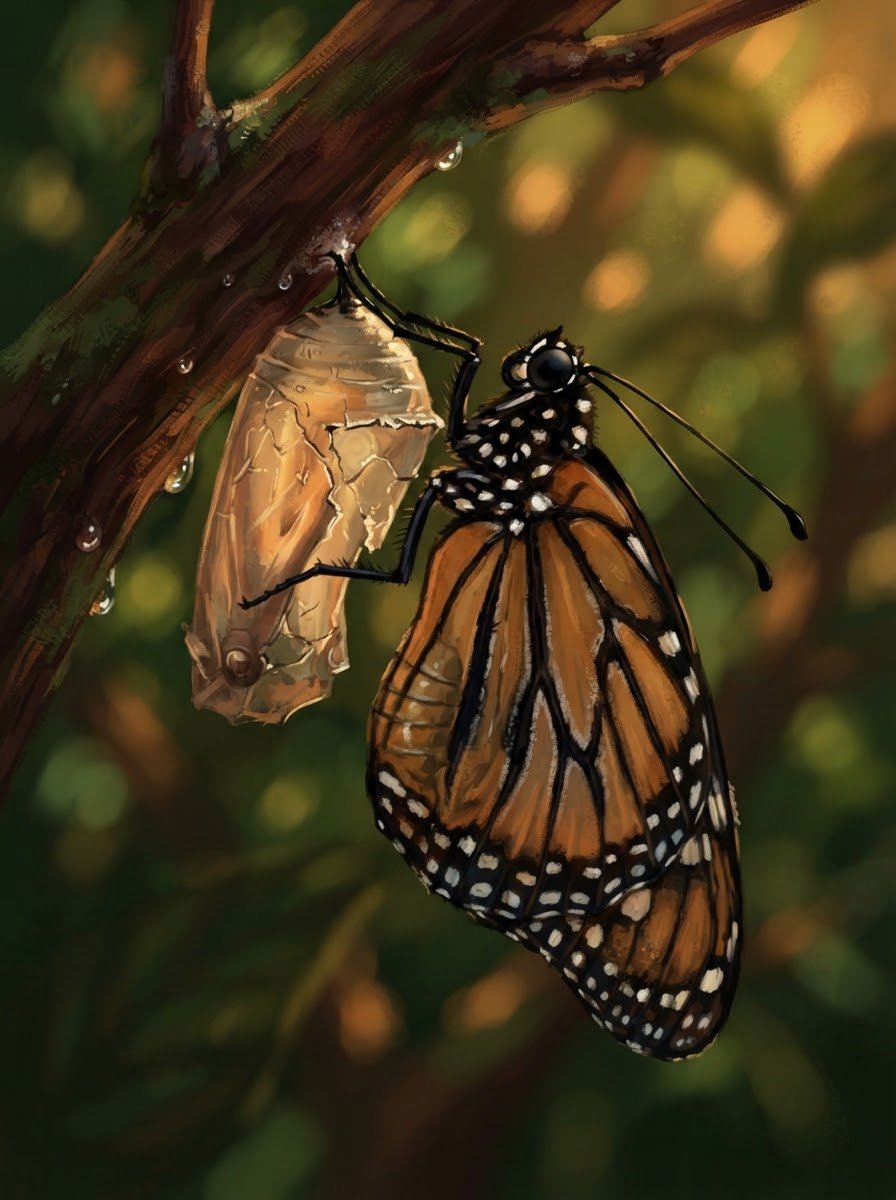
Chapter 11: The Glass Slipper Breaks & Chapter 12: Pumping Life. Ten days pass. The chrysalis becomes transparent, revealing the orange and black wings tightly folded inside. Suddenly, the casing snaps open. The butterfly—the "imago"—crawls out, but it is not yet ready for flight. Its abdomen is swollen with fluid, and its wings are crumpled like wet tissue paper. Hanging vertically, it pumps "hemolymph" from its body into the veins of its wings. Slowly, the wings expand, flatten, and begin to harden in the summer air. Nature Fact: 1. The emergence of a butterfly from its chrysalis is scientifically known as "eclosion." 2. If a butterfly cannot hang vertically after eclosion, its wings will dry crumpled, and it will never be able to fly.
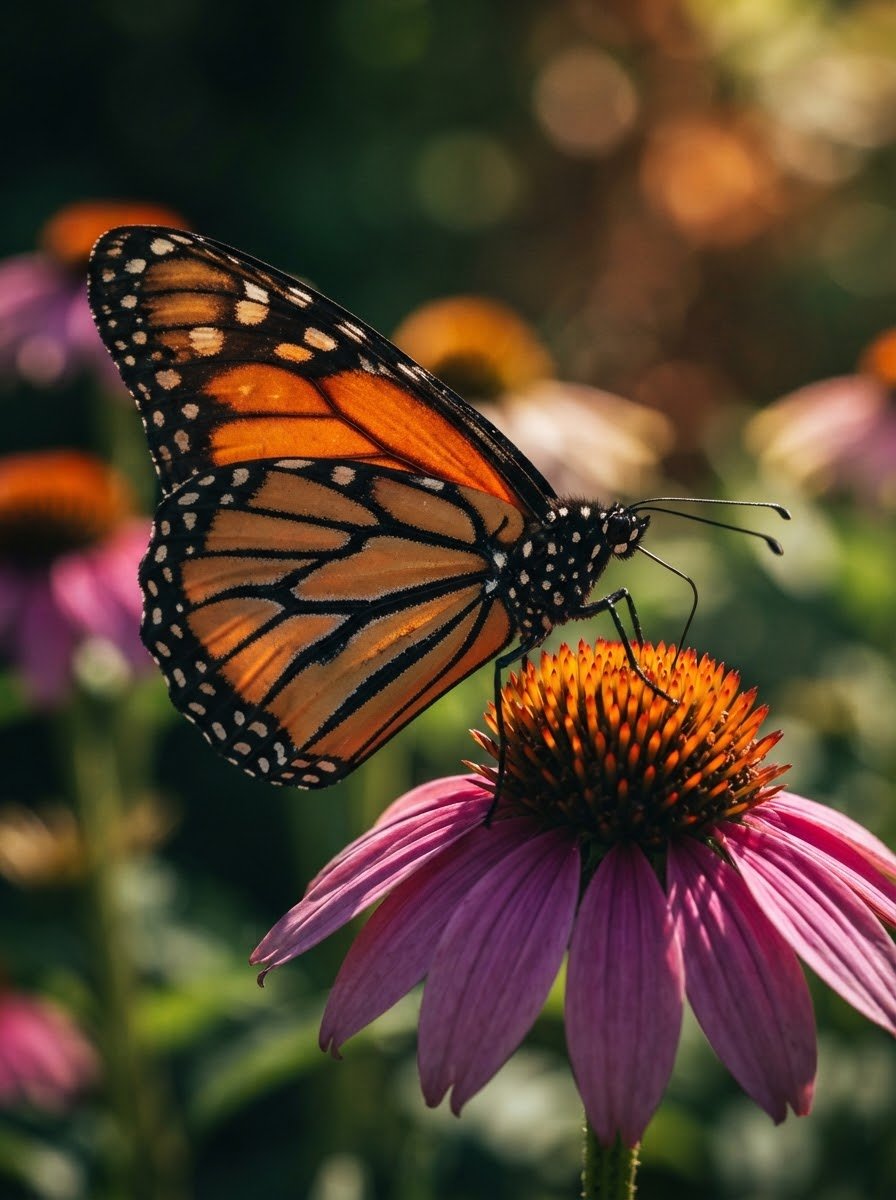
Chapter 13: Taking to the Skies. The transformation is complete. The butterfly releases its grip and takes its first clumsy flight toward a cluster of flowers. It unfurls its "proboscis"—a straw-like tongue—to drink nectar, refueling its energy. Its compound eyes see ultraviolet patterns on the petals that are invisible to humans. Every movement is calculated. It is no longer a restricted crawler but a navigator of the winds, designed for a much larger purpose. Nature Fact: 1. A butterfly’s wings are covered in thousands of tiny, overlapping scales, which provide color and help with thermoregulation. 2. The proboscis is actually two separate parts that the butterfly must "zip" together after emerging from the chrysalis.

Chapter 14: The Great Migration. As the days shorten, a special generation of Monarchs is born: the "Methuselah" generation. Unlike their parents, they do not reproduce immediately. Instead, they turn south. Using an internal magnetic compass and the position of the sun, they begin a 3,000-mile journey to the Oyamel fir forests of Mexico. They soar on thermals, traveling up to 100 miles a day. They are the only butterflies to perform a two-way migration similar to birds, a feat of endurance unmatched in the insect world. Nature Fact: 1. Migrating Monarchs can live up to eight months, whereas summer generations only live two to six weeks. 2. They use "magnetoreception," sensing the Earth's magnetic field through special proteins in their eyes.
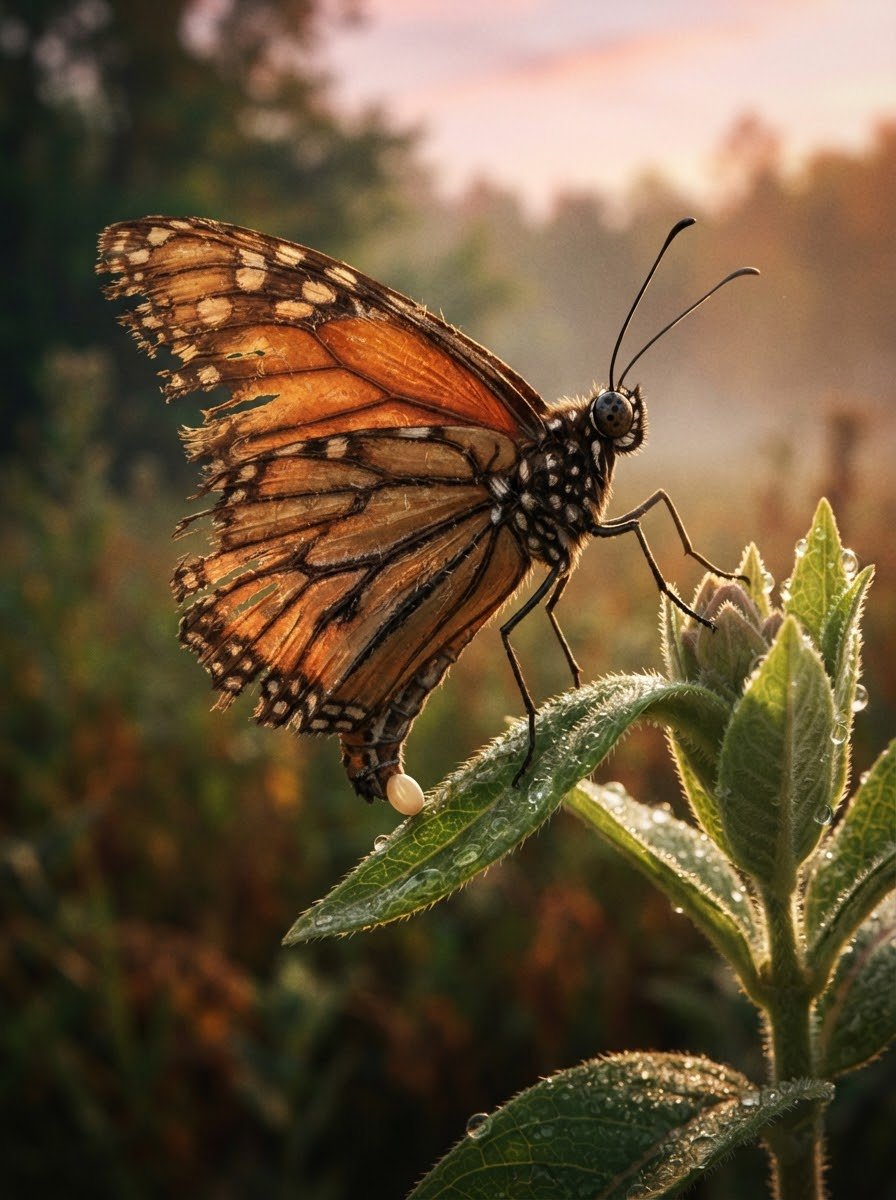
Chapter 15: The Golden Legacy. In the spring, the survivors fly north. They reach the southern United States, where the cycle begins anew. A female finds a fresh milkweed sprout, and the golden legacy continues.