
THE SABER-TOOTHED PREDATOR: SMILODON
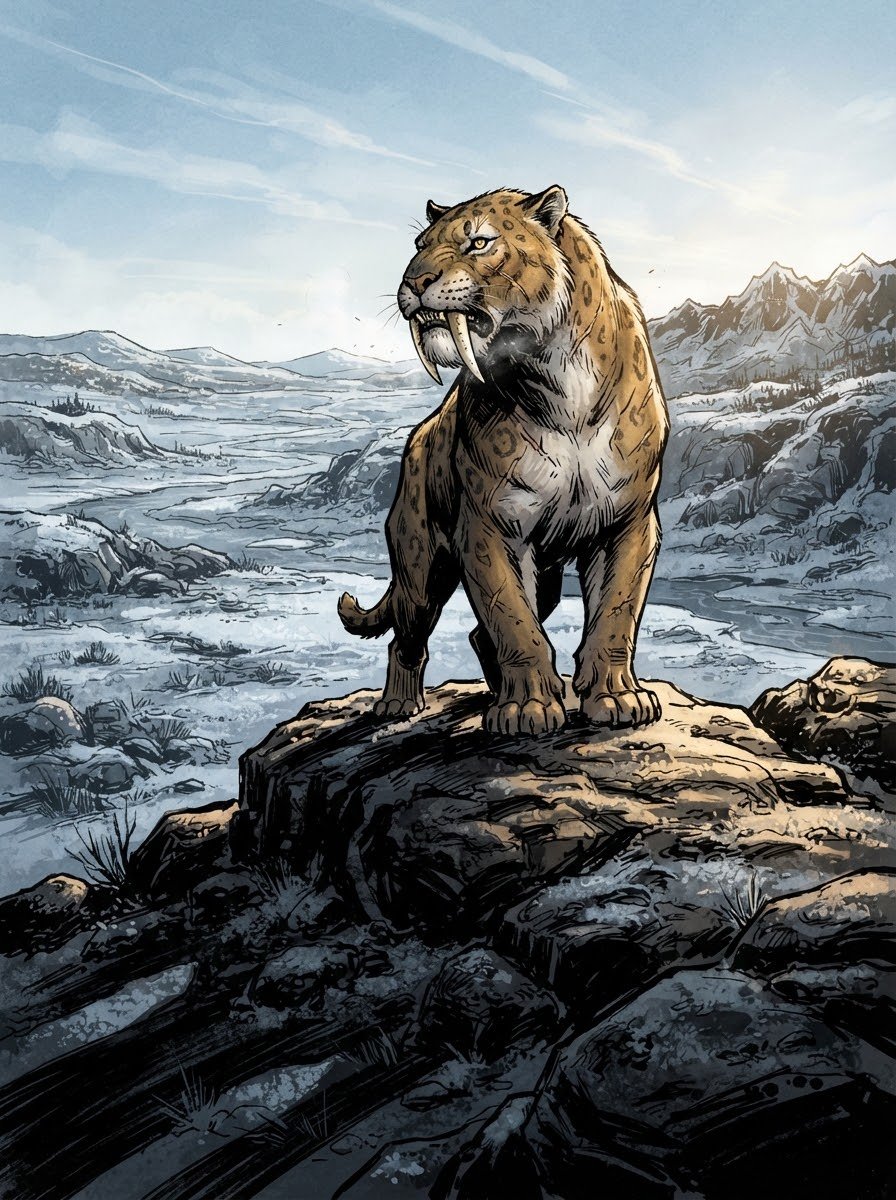
The Saber-Toothed Predator During the Pleistocene Epoch, from about 2.5 million to 10,000 years ago, powerful saber-toothed cats ruled the Americas. Among them stood Smilodon, an apex predator engineered for ambush and lethal precision. Step into the icy realm of the late Pleistocene and discover the natural history of one of the most formidable mammalian hunters ever to walk the Earth.
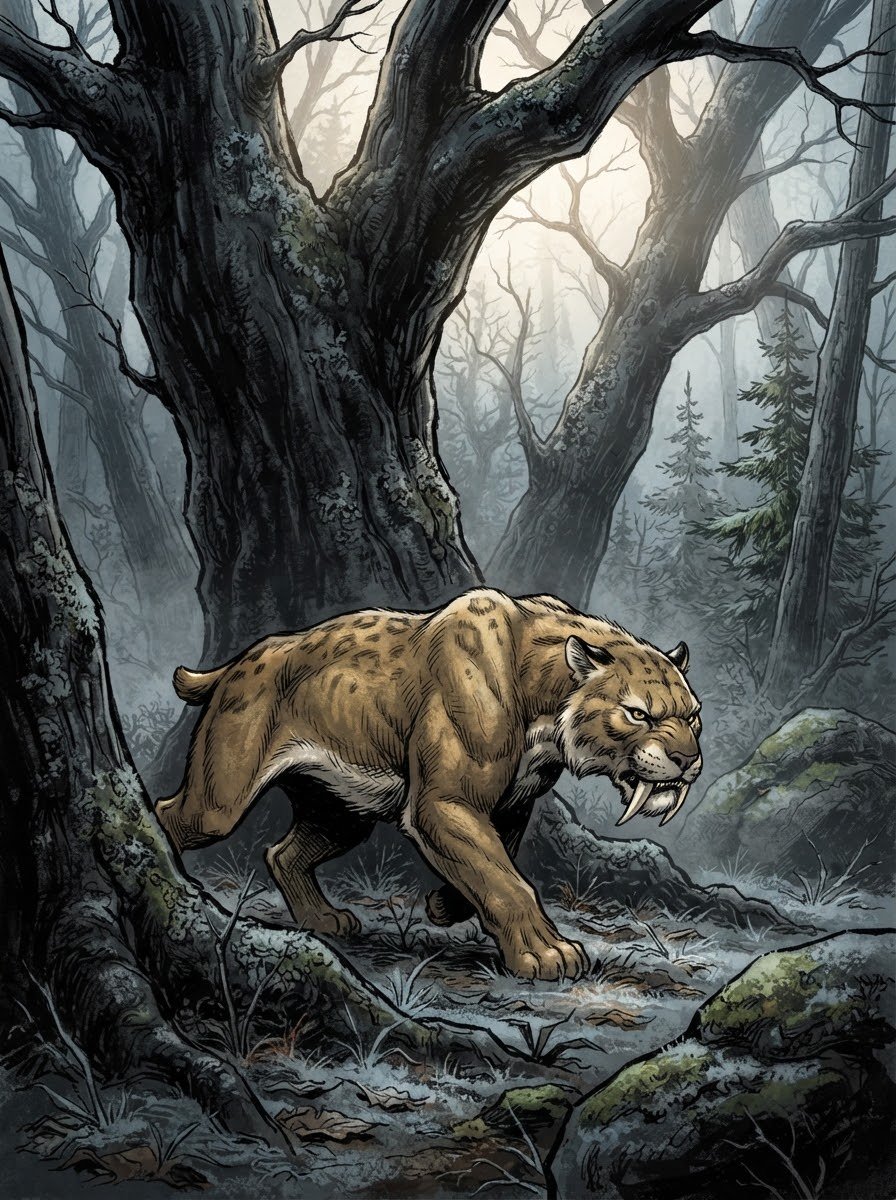
A Continent in the Grip of Ice Eleven thousand years ago, North America was a dynamic landscape of cold steppe grasslands, pine woodlands, and expanding glaciers. Towering herbivores roamed these rich open valleys, while swift predators prowled the forest margins. Moving silently through a frost-dusted oak wood in modern-day California is Kael, a fully grown Smilodon fatalis surveying his territory.
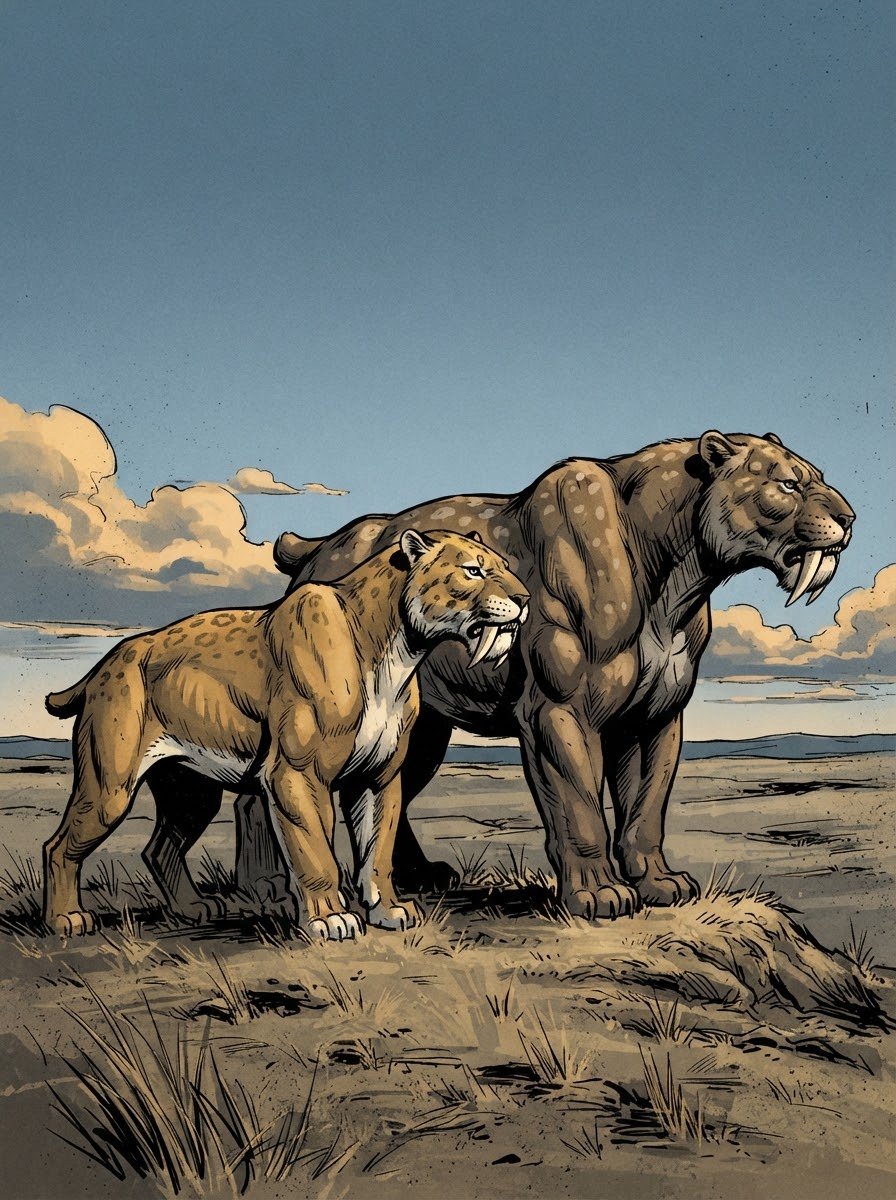
The Three Species of Smilodon The genus Smilodon evolved over millions of years into three distinct species that adapted to different eras and environments across the Americas. From the smaller ancestral Smilodon gracilis to the medium-sized Smilodon fatalis, and finally the massive South American Smilodon populator, each species perfected the saber-toothed hunting strategy.
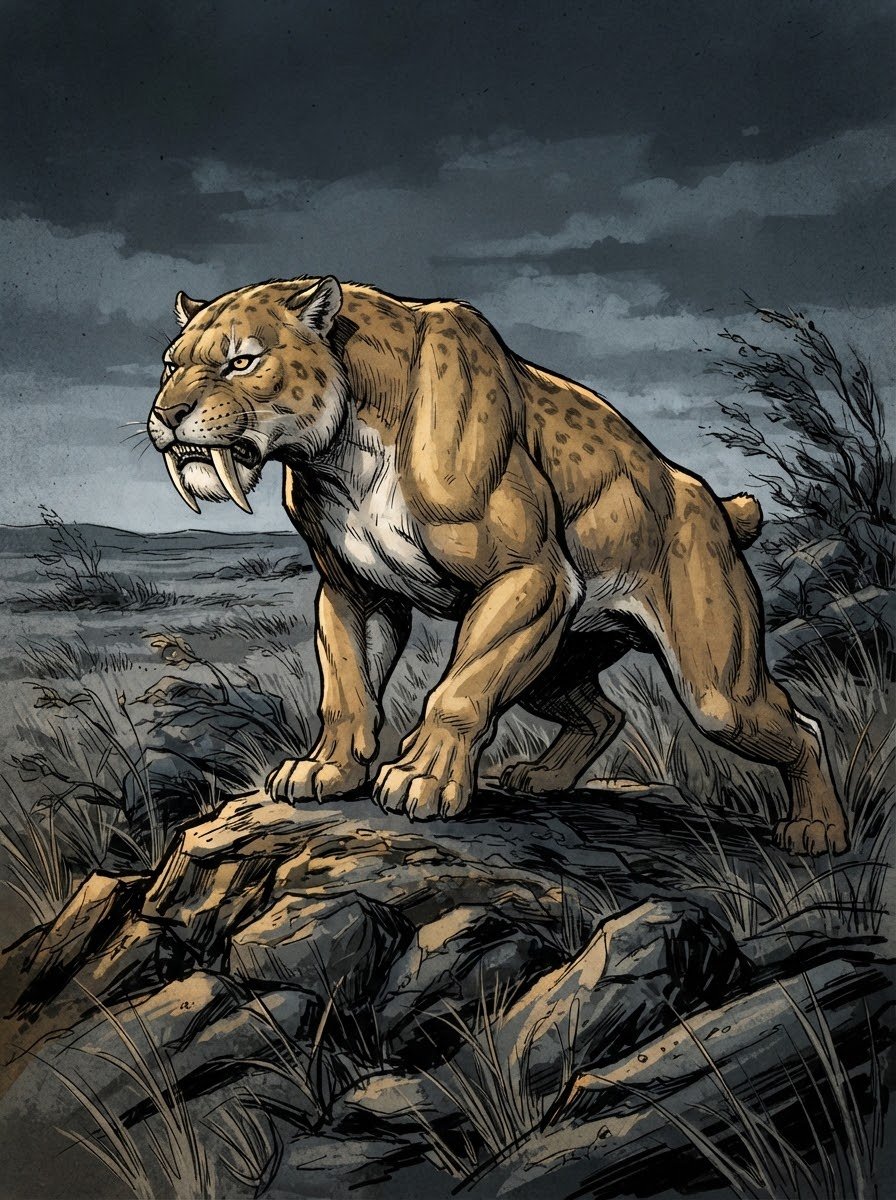
Engineered for Power, Not Speed Unlike slim modern cheetahs or long-distance hunting wolves, Smilodon was built like a heavyweight wrestler. With a unusually short bobtail, broad chest, and exceptionally powerful front legs, Kael was not designed for long high-speed chases. Instead, his entire skeleton was optimized for explosive ambush power and wrestling massive prey to the ground.
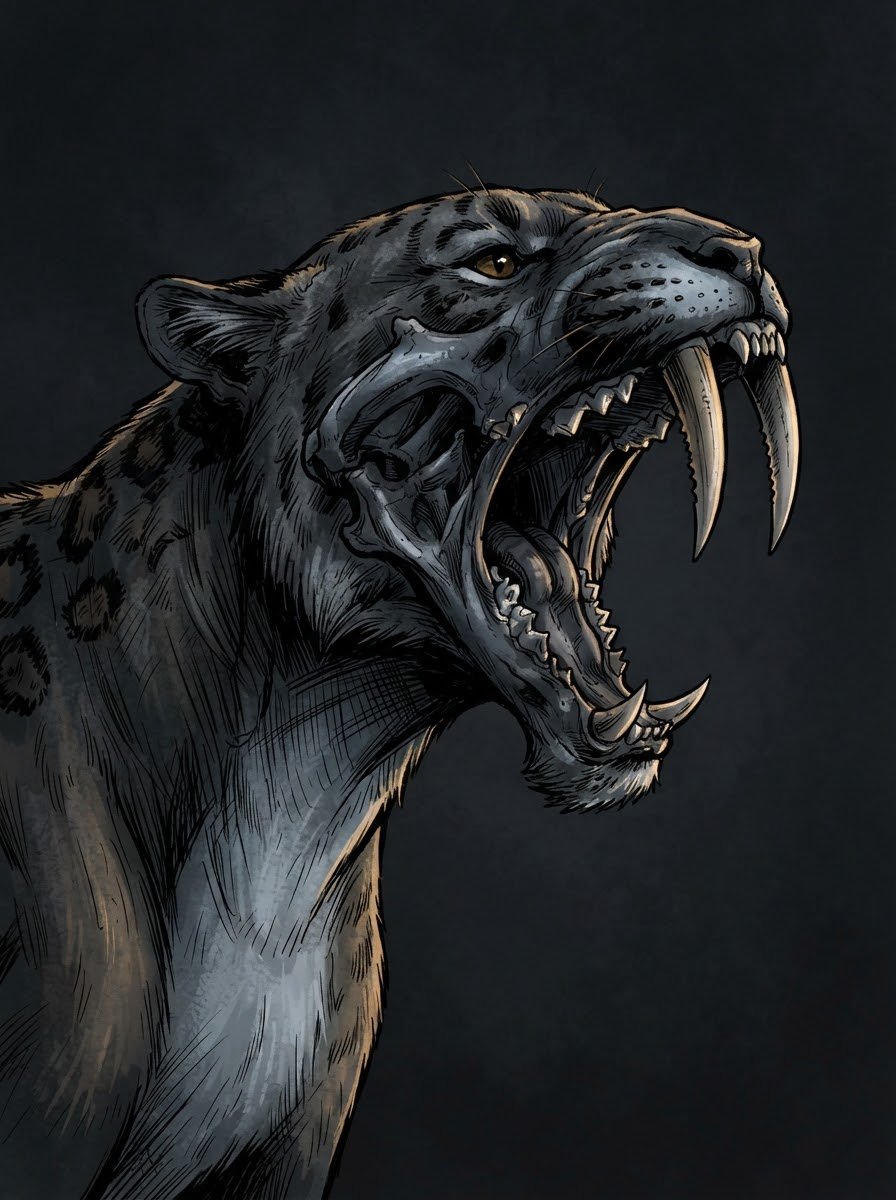
The Weaponry: Legendary Canines The defining feature of Smilodon was its pair of massive, flattened upper canine teeth, which could reach up to 28 centimeters (11 inches) in length including the roots. Serrated along both front and back edges, these impressive sabers were precision cutting tools designed to deliver a rapid, lethal slash to a victim's throat or neck.
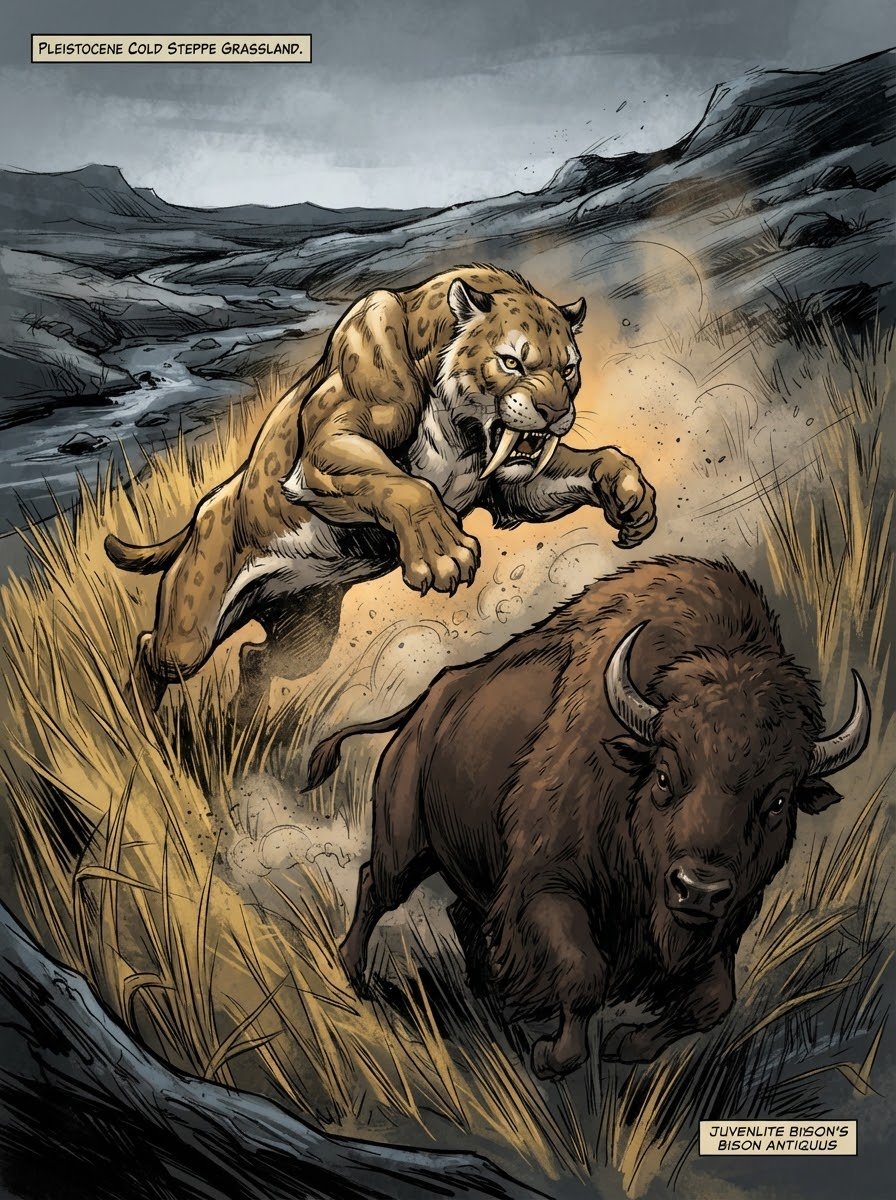
The Stalk and Ambush Crouching low among tall dry grasses, Kael locks his gaze onto a young ancient bison (Bison antiquus) grazing near a stream. Staying downwind, Kael uses every patch of brush for cover, inching forward millimeter by millimeter. Once within striking distance, he bursts forward in a sudden, violent charge, using the element of surprise to close the distance before the bison can flee.
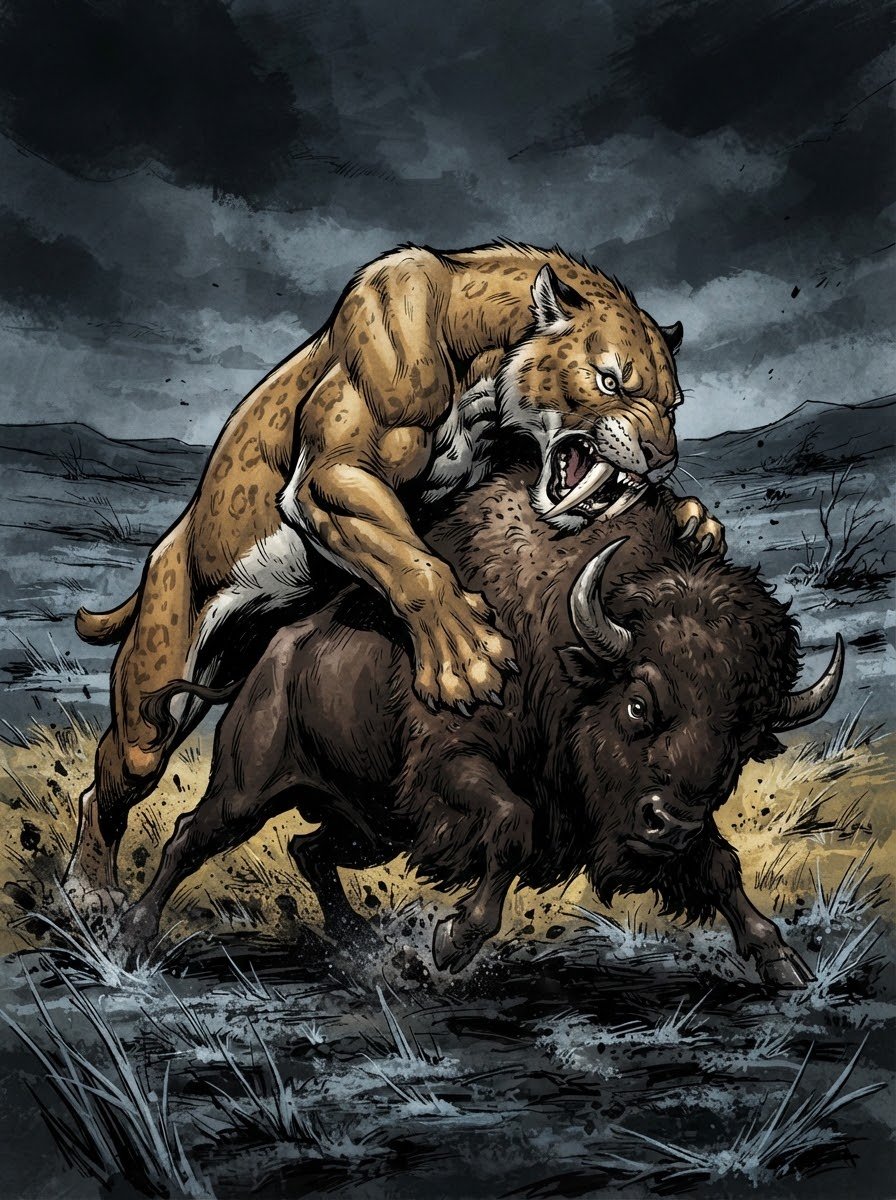
Delivering the Fatal Strike Closing in instantly, Kael hurls his heavy front legs over the bison's shoulders, locking his powerful claws into its hide and slamming the animal to the turf. Controlling the thrashing prey with his formidable chest and arm muscles, Kael drives his head forward, plunging his curved saber teeth into the soft tissues of the bison's throat for a rapid kill.
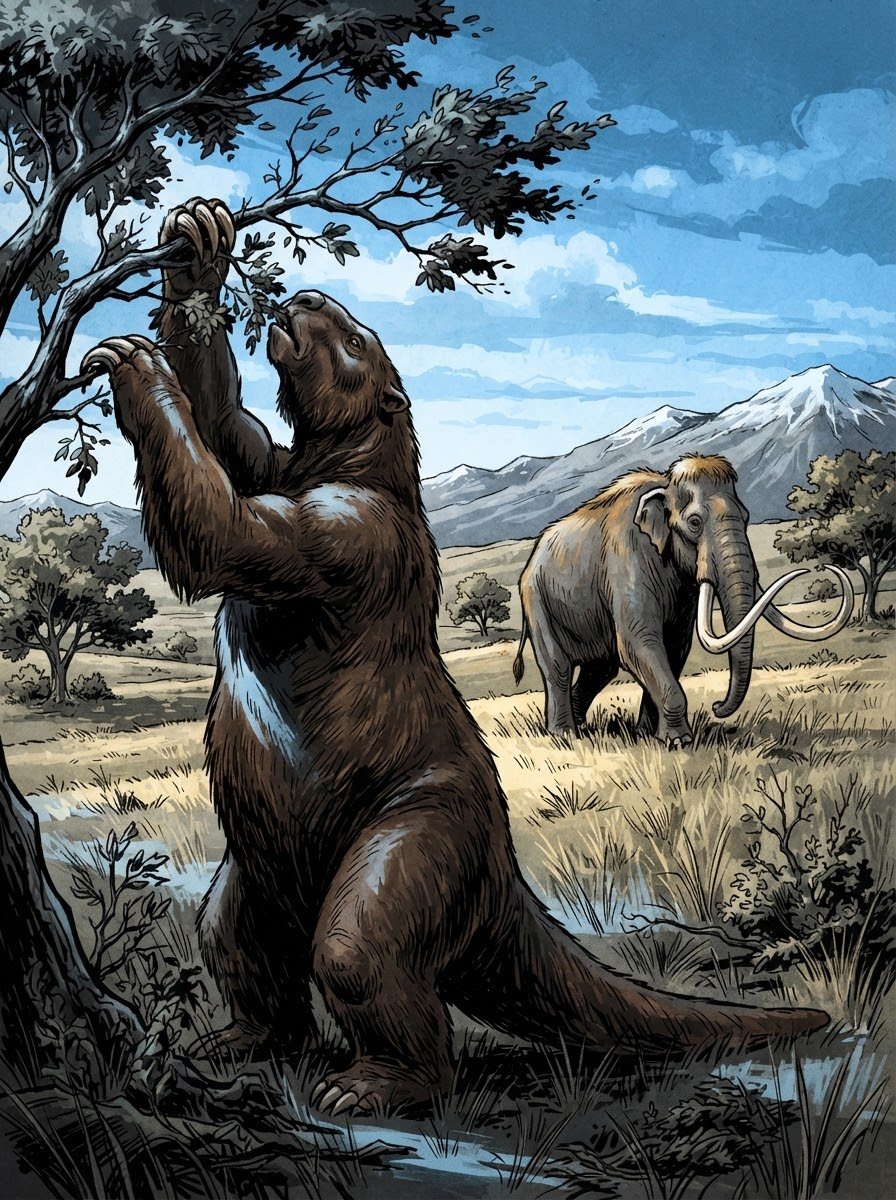
Giant Neighbors of the Pleistocene Smilodon shared its vast habitat with an astonishing array of Ice Age giants. Giant ground sloths (Paramylodon) tore down tree branches with massive claws, while long-horned bison swept across plains in massive herds. Nearby, towering Columbian mammoths (Mammuthus columbi) moved like living mountains, shaping the landscape and creating open pathways through dense woods.
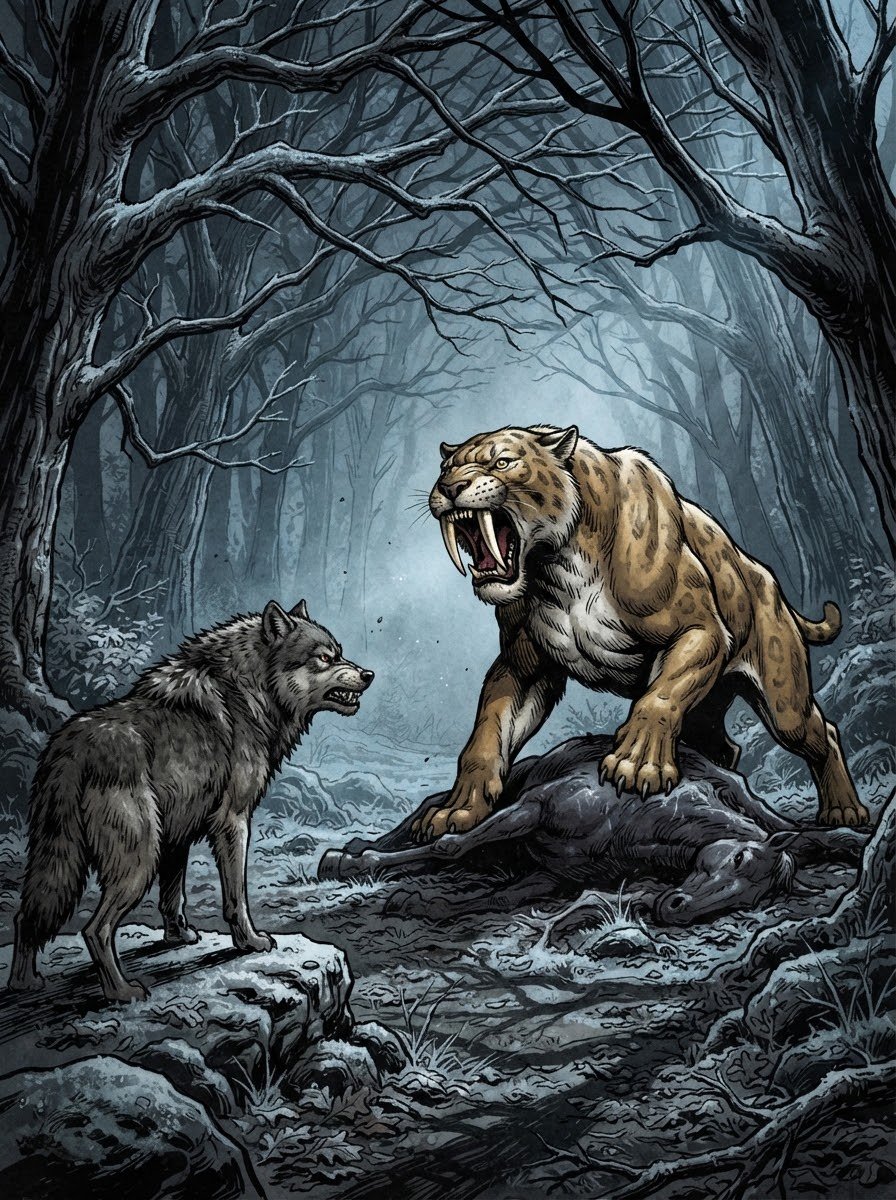
Rivals of the Ice Age Claiming a kill was only half the battle; defending it was equally dangerous. Smilodon faced fierce competition from rival predators, including packs of dire wolves (Aenocyon dirus) and the enormous short-faced bear (Arctodus simus). When a dire wolf approaches Kael's fresh kill, he bristles his back and snarls, displaying his menacing saber teeth to guard his meal.
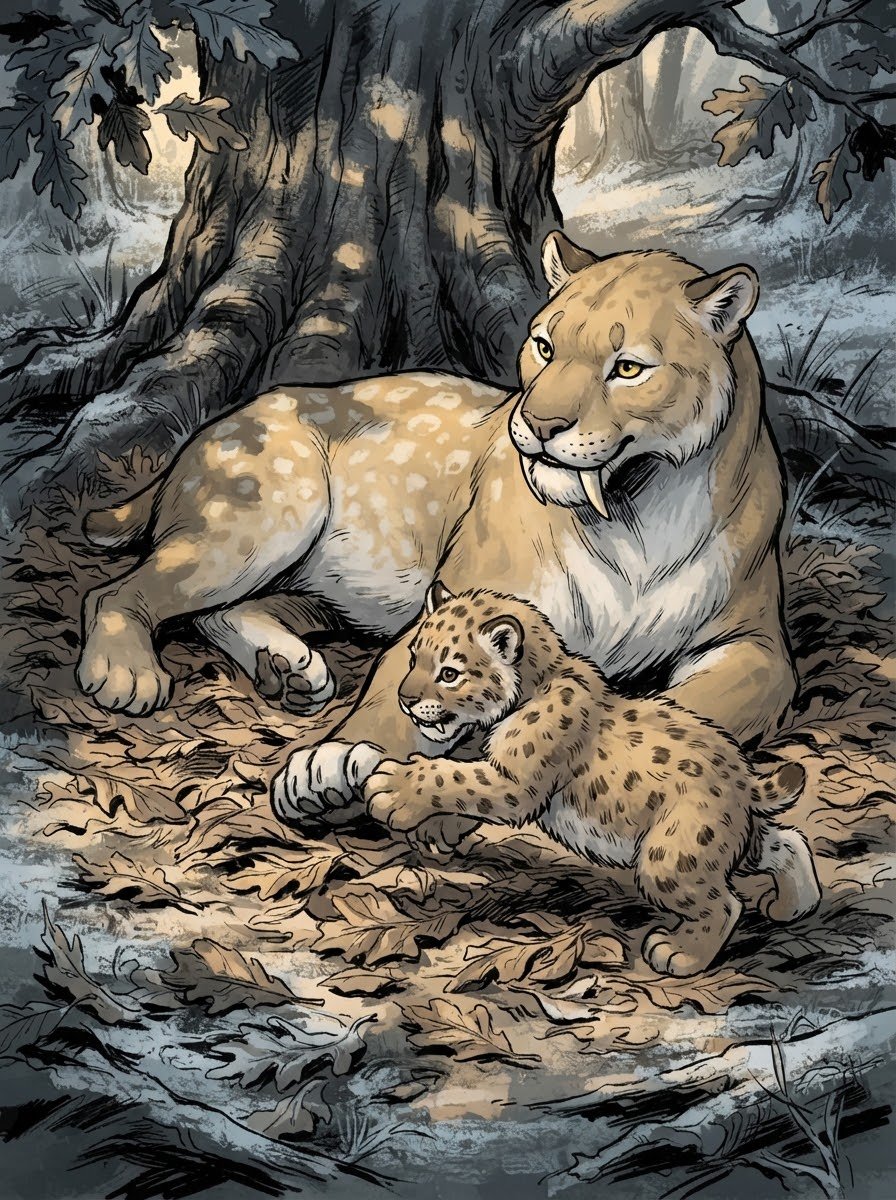
Family and Social Life Did Smilodon live in pride-like groups like modern lions, or lead solitary lives like tigers? Fossil evidence offers intriguing clues. A female Smilodon, Lyra, rests in the shade of an oak tree while her young cub plays near her feet. Fractured bones on adult fossils show clear signs of healing, suggesting pack members may have shared food with injured individuals.
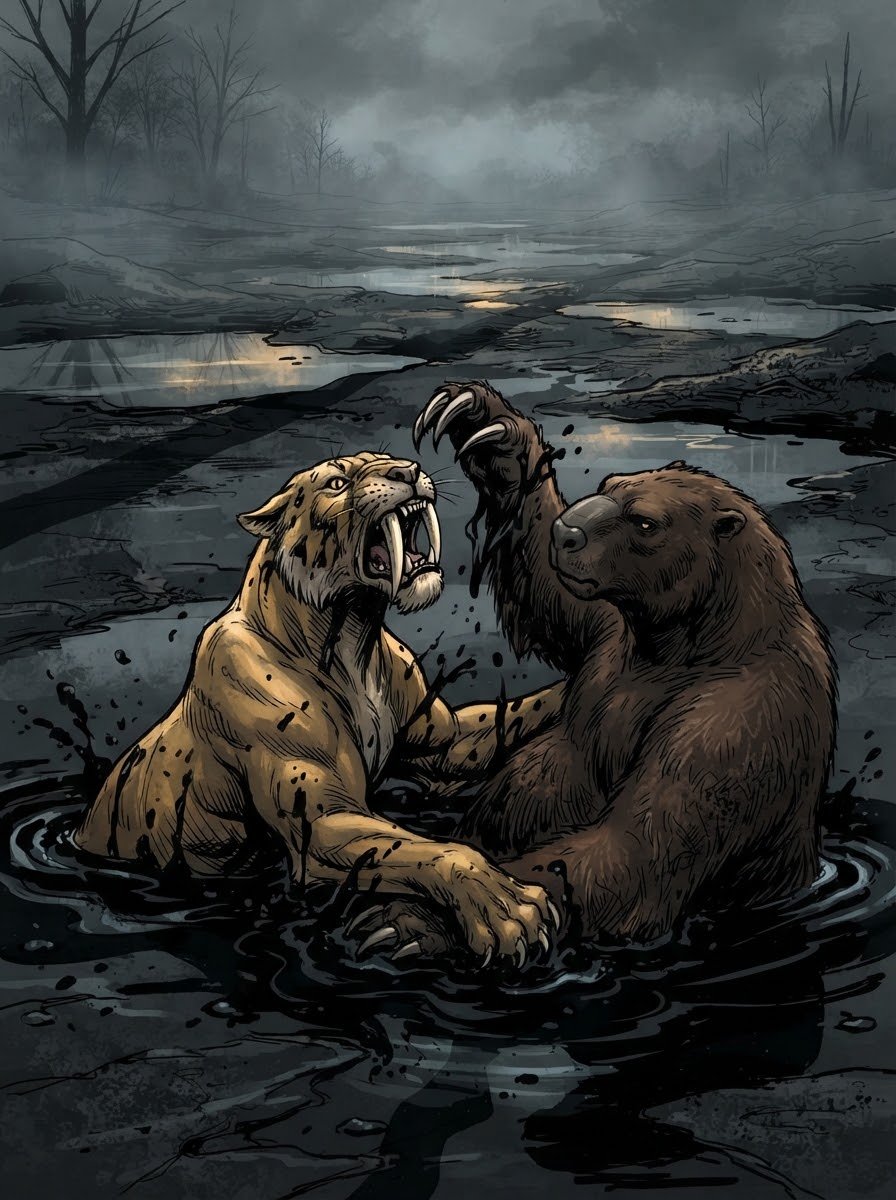
The Natural Asphalt Traps Deep in the Los Angeles Basin, natural asphalt spring pools bubbled up through fissures in the earth. Covered by thin layers of rainwater and leaves, these treacherous tar pits became deadly natural traps. When a large herbivorous sloth became stuck in the sticky tar, its distress cries attracted hunting predators like Smilodon, drawing them into the same fatal trap.

Secrets of La Brea Tar Pits Over tens of thousands of years, asphalt tar preserved millions of bones in exquisite detail. Today, at active excavation sites in Los Angeles, paleontologist Dr. Elena Vance carefully unearths a complete Smilodon skull from a block of dark, bitumen-rich sediment. Every tooth mark, fracture, and growth ring provides vital clues about how these animals lived and died.
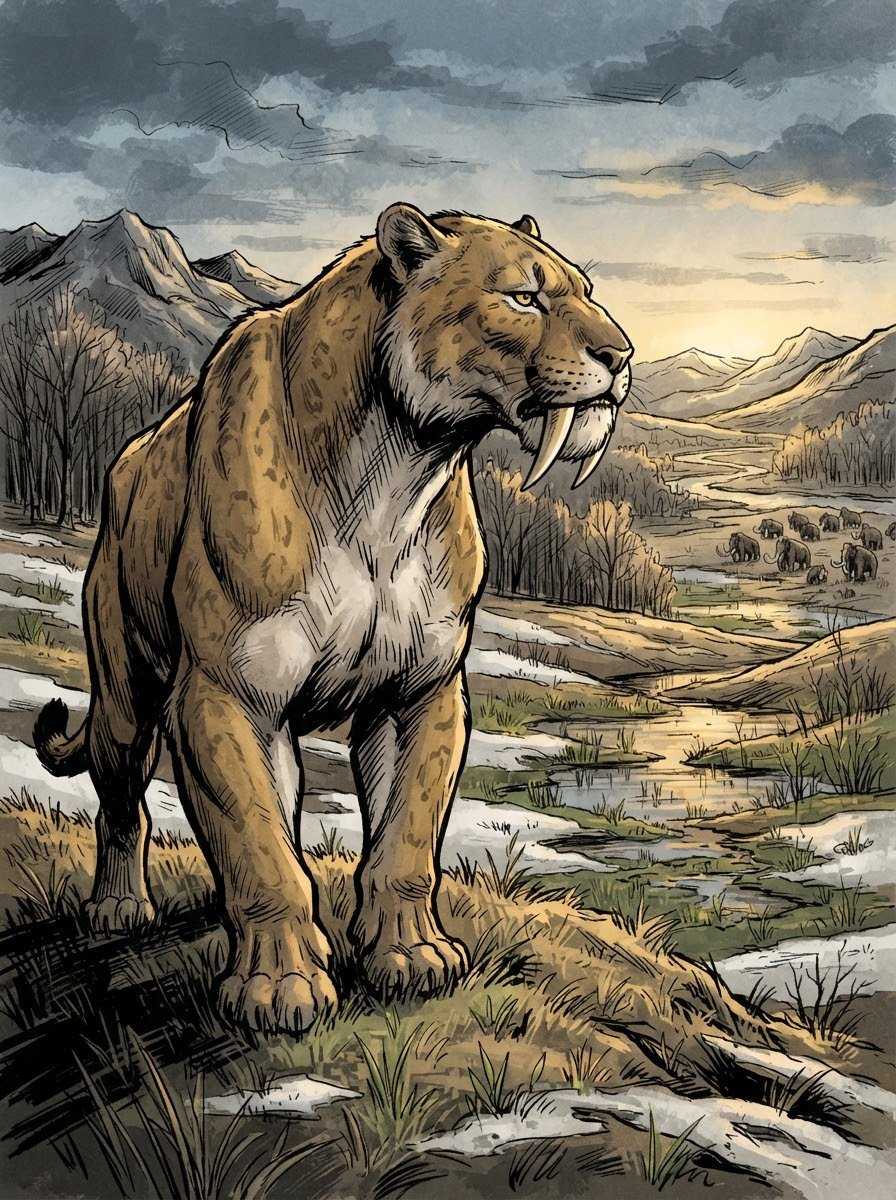
The Changing World Around 12,000 to 10,000 years ago, Earth's climate rapidly warmed as the last glacial period came to an end. Ecosystems shifted dramatically: cold grasslands turned into dense forests or arid brushlands, and many large megafaunal species—the primary food source for Smilodon—began to vanish across the Americas.
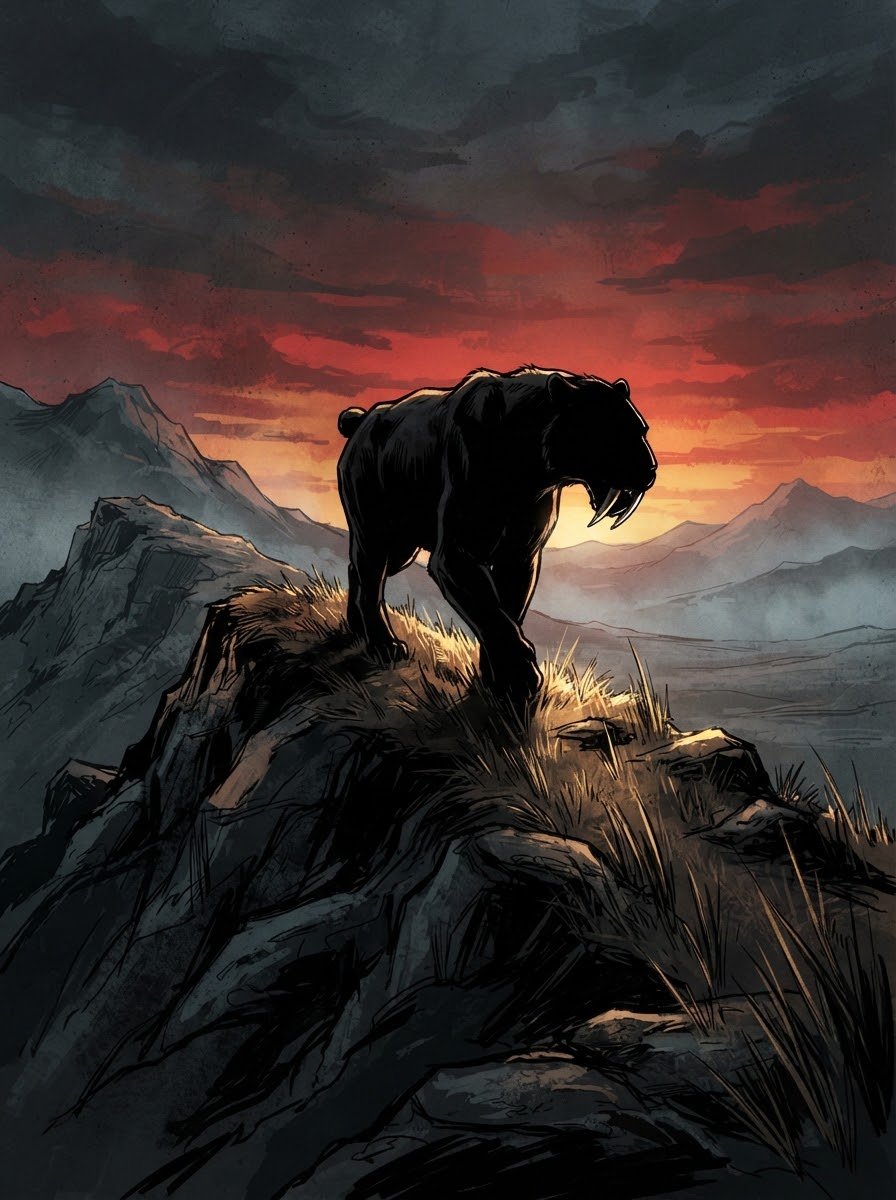
The Shadow of Extinction Along with rapid climate change came another powerful catalyst: the expansion of human hunters across the continent. Armed with spears, throwing sticks, and advanced cooperative hunting strategies, humans competed for prey and altered habitat fire regimes. Deprived of its giant prey and outcompeted in a changing world, Smilodon faded into history around 10,000 years ago.
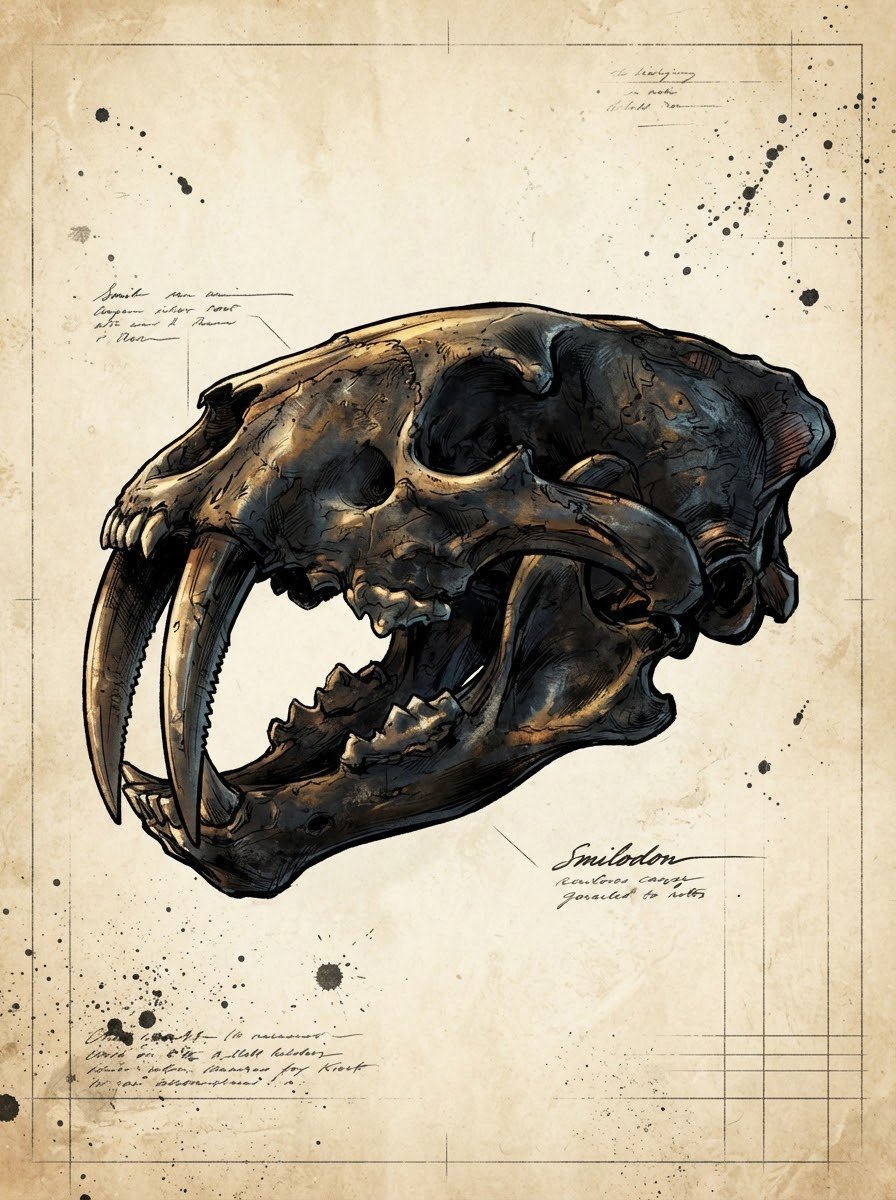
Smilodon Fact File SMILODON — SCIENTIFIC FACT FILE • Scientific Name: Smilodon (S. gracilis, S. fatalis, S. populator) • Temporal Range: Early Pleistocene to Late Pleistocene (~2.5 million to 10,000 years ago) • Classification: Class Mammalia, Order Carnivora, Family Felidae, Subfamily Machairodontinae • Estimated Weight: S. gracilis (50–100 kg); S. fatalis (160–280 kg); S. populator (220–400+ kg) • Shoulder Height: ~1.0 to 1.2 meters (3.3 to 4 feet) • Key Weapon: Recurved upper canine teeth up to 28 cm (11 in) long including roots • Diet: Large megaherbivores (bison, ground sloths, camels, young mammoths) • Key Fossil Sites: La Brea Tar Pits (California), Florida deposits, Talara Tar Seeps (Peru), Pampas (Argentina)

Legacy of the Saber-Tooth Millions of years after its extinction, Smilodon remains an enduring icon of prehistoric life, capturing human imagination and inspiring scientific inquiry. Today, inside a modern natural history museum, Dr. Elena Vance stands before a full-body mounted skeleton of Smilodon fatalis, teaching a young student about the power and fragile balance of ancient ecosystems.