
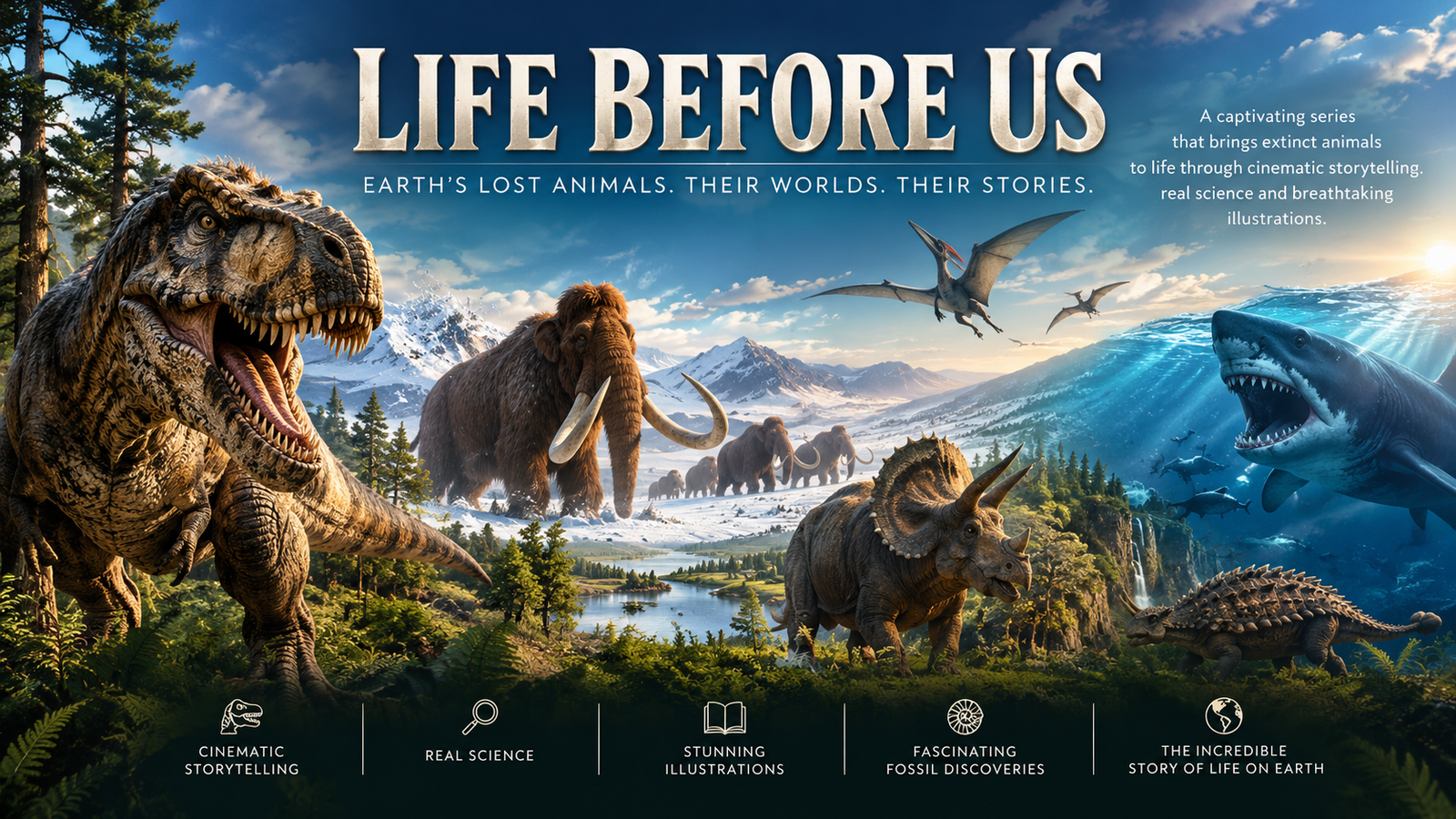
LIFE BEFORE US
LIFE BEFORE US — Earth's Lost Animals. Their Worlds. Their Stories. Journey millions of years into Earth's past with LIFE BEFORE US, an illustrated natural-history series exploring the extraordinary animals that once roamed our planet. From the mighty Tyrannosaurus rex and woolly mammoths to colossal prehistoric sharks, saber-toothed predators, and bizarre ancient creatures, each book brings a lost world to life through cinematic storytelling, wildlife-documentary-style narratives, and fascinating scientific discoveries. Discover how these animals lived, hunted, survived, adapted to their environments, and eventually disappeared. Explore their remarkable anatomy, ancient ecosystems, fossil evidence, and the scientific mysteries that researchers are still working to solve. Combining immersive storytelling, stunning illustrations, and reliable scientific knowledge, LIFE BEFORE US invites readers to experience the wonders of prehistoric Earth and uncover the incredible stories hidden within its fossils. The world has changed. The creatures are gone. Their stories live on.
Chronological Episodes
6 Episodes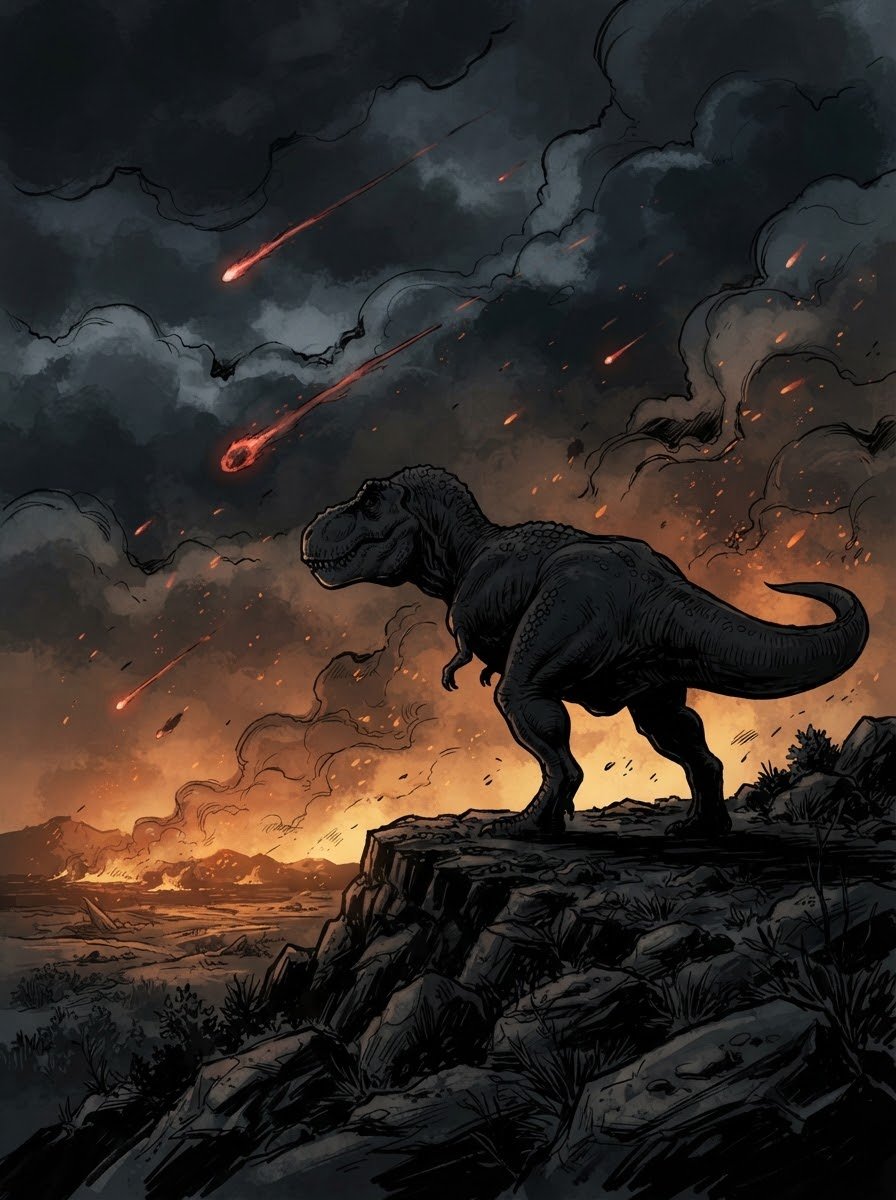
THE KING OF THE LOST WORLD: TYRANNOSAURUS REX
Sixty-six million years ago, in the ancient landscapes of western North America, one of the most formidable predators ever to walk on land ruled its ecosystem. Its name was Tyrannosaurus rex. Journey into the Late Cretaceous world of this extraordinary dinosaur, exploring its powerful jaws, remarkable senses, hunting strategies, daily challenges, and place in a world filled with other fascinating creatures. Through cinematic storytelling, realistic wildlife-documentary scenes, and fascinating scientific discoveries, witness a reconstructed day in the life of T. rex. Discover what it might have hunted, how its body was adapted for survival, what its fossils reveal, and what scientists are still trying to understand. But this is more than the story of a giant predator. It is the story of an ancient ecosystem, the remarkable history of life on Earth, and the catastrophic environmental changes that brought the age of non-avian dinosaurs to an end. Step into a world that disappeared millions of years before humans existed. The evidence survives in stone. The story begins here.
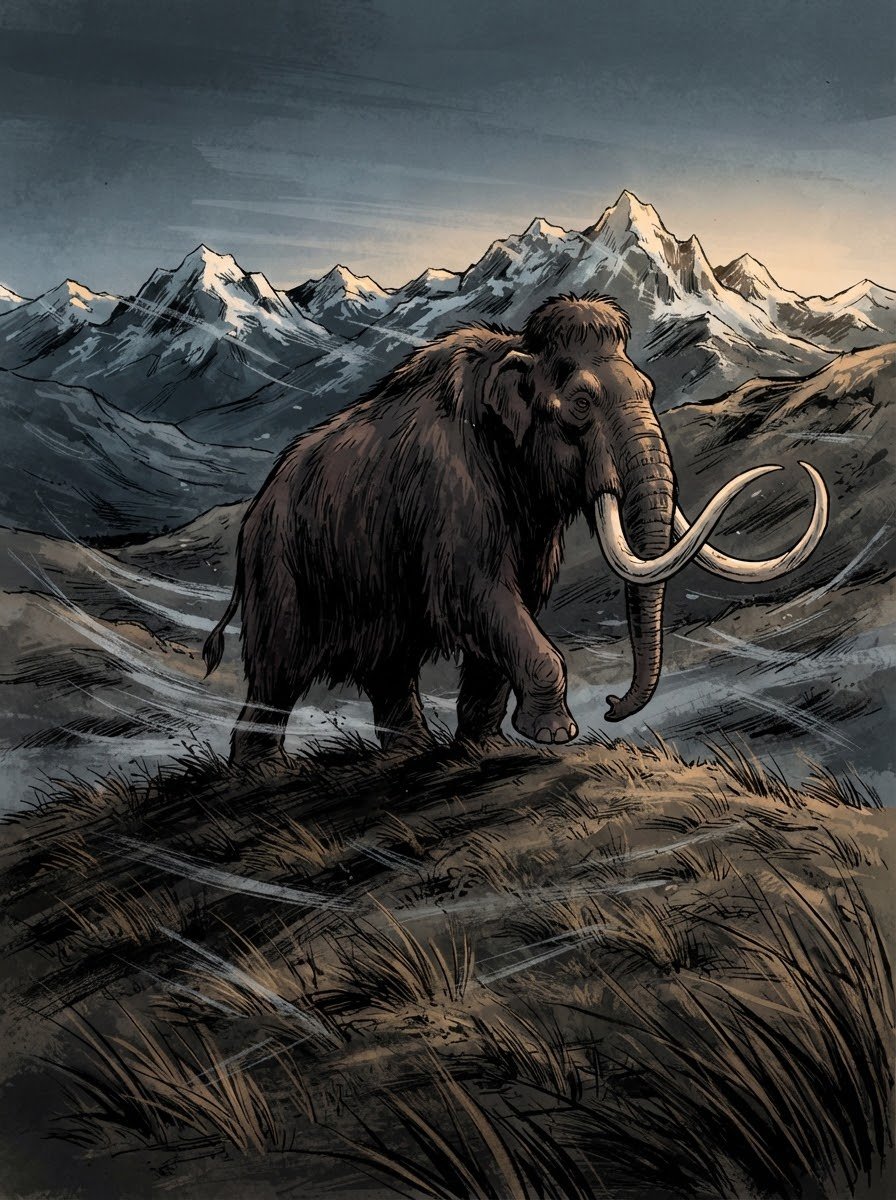
GIANT OF THE FROZEN WORLD: WOOLLY MAMMOTH
Millions of years of evolution created an extraordinary survivor. The frozen world became its home. Step into the Ice Age, when vast grasslands stretched across the northern continents and enormous woolly mammoths wandered through a world of snow, wind, and ice. Meet the woolly mammoth, an extraordinary relative of modern elephants, equipped with thick fur, a protective layer of body fat, and long, curved tusks. Discover how these magnificent animals searched for food beneath the snow, traveled across cold landscapes, cared for their young, and survived in one of Earth's most challenging environments. Through cinematic storytelling, wildlife-documentary-style scenes, and fascinating scientific discoveries, explore the mammoth's daily life, family groups, physical adaptations, and relationship with early humans. Travel from the windswept mammoth steppes to the frozen landscapes where their remains were preserved for thousands of years. Uncover what their bones, teeth, tusks, and preserved tissues reveal about their lives—and investigate the environmental changes and human activities that contributed to the disappearance of many mammoth populations. But the story does not end with extinction. Some mammoths survived long after the Ice Age began to fade, leaving behind remarkable clues about the final chapters of their existence. Discover the giant that conquered the cold, the world it inhabited, and the mysteries it left behind. LIFE BEFORE US — Earth's Lost Animals. Their Worlds. Their Stories.
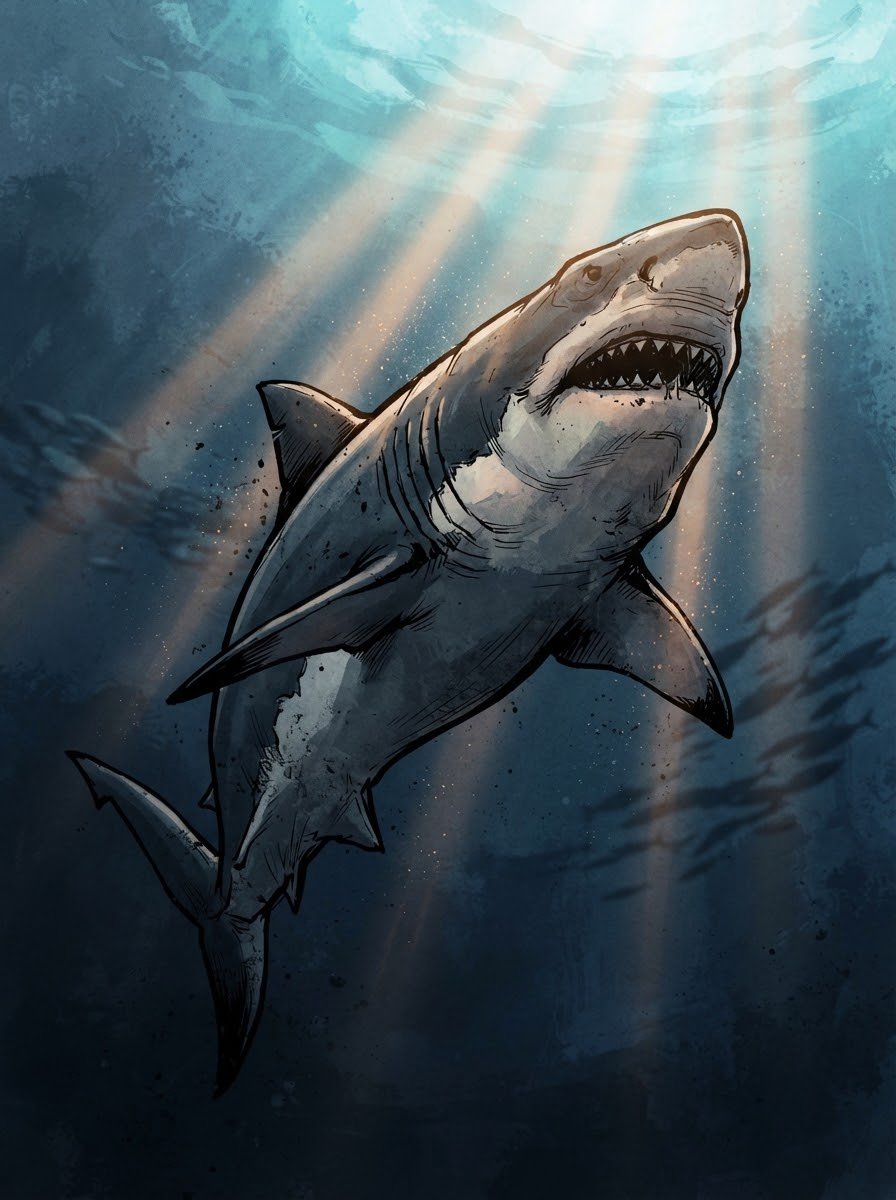
TITAN OF THE ANCIENT OCEANS: MEGALODON
Long before modern oceans took their present form, an extraordinary predator moved through Earth's ancient seas. Its name was Megalodon. With enormous jaws, powerful swimming muscles, and teeth built for gripping and cutting prey, this extinct shark became one of the most formidable marine predators known to science. Journey millions of years into the past to explore the world of Megalodon. Discover how this giant shark may have hunted, what it ate, how scientists estimate its size from fossil teeth and vertebrae, and what its anatomy reveals about life in prehistoric oceans. Through cinematic storytelling, wildlife-documentary-style scenes, and fascinating scientific discoveries, encounter ancient marine mammals, explore changing ocean ecosystems, and investigate the evidence preserved in fossil deposits around the world. But even a powerful predator depends on its environment. As ocean conditions and marine ecosystems changed, Megalodon eventually disappeared. Scientists continue to investigate the complex factors that may have contributed to its extinction. What did this giant shark really look like? How large could it grow? And what can its fossil record reveal about the rise and fall of a remarkable predator? Dive into the ancient oceans and uncover the story of Megalodon—a giant that vanished, but whose fossil teeth still reveal clues about its extraordinary life.
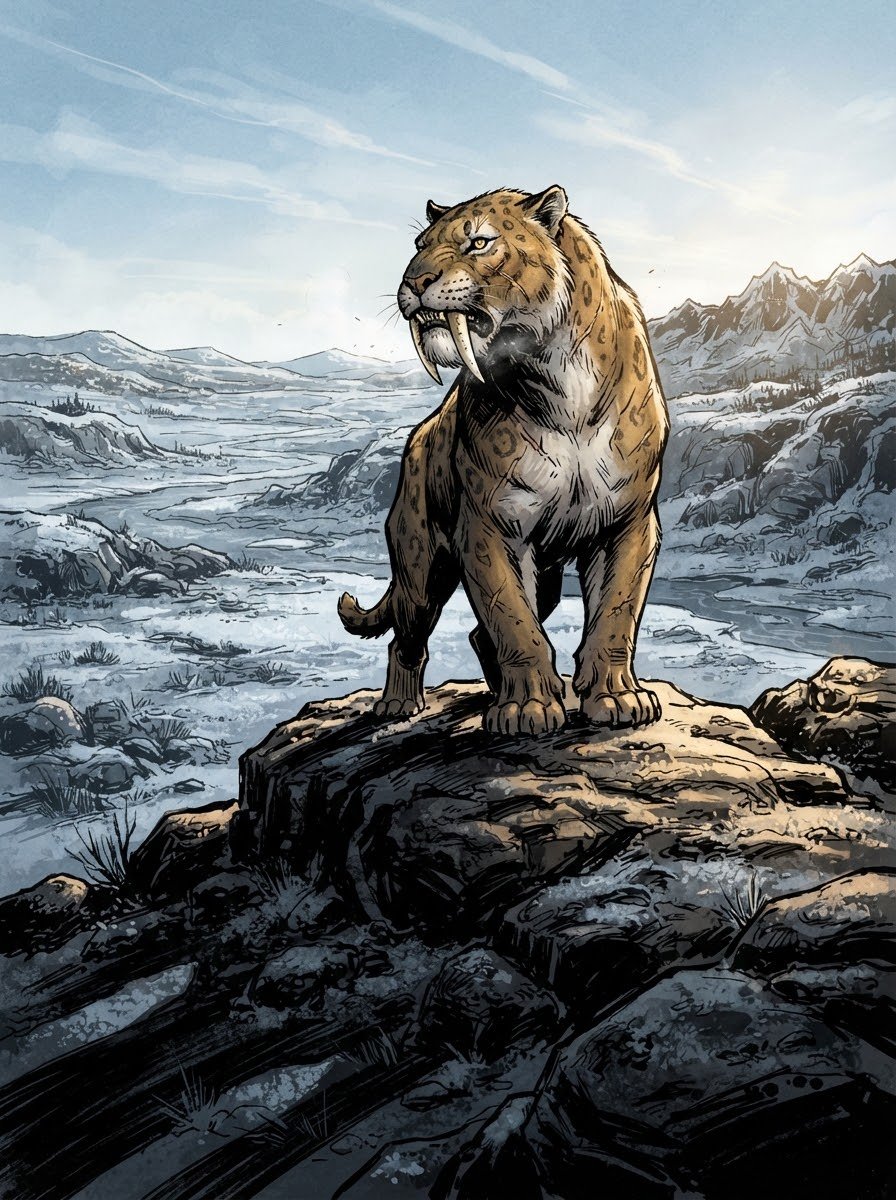
THE SABER-TOOTHED PREDATOR: SMILODON
Imagine walking across an ancient landscape where enormous mammals roam, giant herbivores graze across open grasslands, and powerful predators wait for the right moment to strike. Among these remarkable creatures lived Smilodon, one of the most recognizable predators of the Ice Age. Famous for its enormous, blade-like upper canine teeth, Smilodon was unlike any big cat alive today. Its powerful forelimbs, muscular body, and distinctive skull made it one of the most fascinating hunters in prehistoric history. Journey into its lost world and discover how this extraordinary predator may have hunted, what it ate, how it lived, and how its remarkable anatomy helped it survive. Explore its relationships with other Ice Age animals, encounter the fossil discoveries that transformed our understanding of its life, and investigate the mysteries surrounding its extinction. Through cinematic storytelling, wildlife-documentary-style narration, and fascinating scientific discoveries, experience the world of Smilodon as never before. Its giant teeth became its legacy. Its fossils preserve clues to its life. Its story reveals the extraordinary diversity of Earth's ancient predators. Meet the hunter whose legendary smile concealed one of nature's most fascinating evolutionary experiments. LIFE BEFORE US — Earth's Lost Animals. Their Worlds. Their Stories.

THE GIANT OF THE ANCIENT SWAMPS: TITANOBOA
Imagine a hot, humid world where enormous trees rise above ancient rivers, giant turtles glide through murky waters, and powerful crocodile relatives patrol the swamps. Hidden beneath the water's surface lives a remarkable predator: Titanoboa, the largest known snake discovered in the fossil record. Travel back around 60 million years to the tropical forests of ancient South America, where Titanoboa ruled the waterways. Discover its extraordinary size, powerful body, hunting adaptations, prehistoric neighbors, and the fossils that revealed its existence. Through cinematic storytelling, fascinating scientific discoveries, and detailed illustrations, explore a lost world where reptiles grew to astonishing sizes—and uncover what Titanoboa teaches us about ancient life and Earth's changing climate.

THE ARMORED TERROR OF THE ANCIENT SEAS: DUNKLEOSTEUS
Long before dinosaurs walked the Earth, ancient oceans were ruled by extraordinary armored fish. Among the most impressive was Dunkleosteus, a powerful predator with a heavily armored head and enormous cutting plates instead of ordinary teeth. Travel back around 360 million years to the Devonian Period, when strange fish filled the seas and life beneath the waves was evolving in remarkable ways. Discover how Dunkleosteus was built, how its unusual jaws worked, what it may have hunted, and how fossils reveal the secrets of this ancient marine predator. Explore a world of armored fish, early sharks, and mysterious underwater ecosystems in a thrilling journey through one of Earth's most fascinating prehistoric ages.