
Structure of the Atom (Class 9 Science)
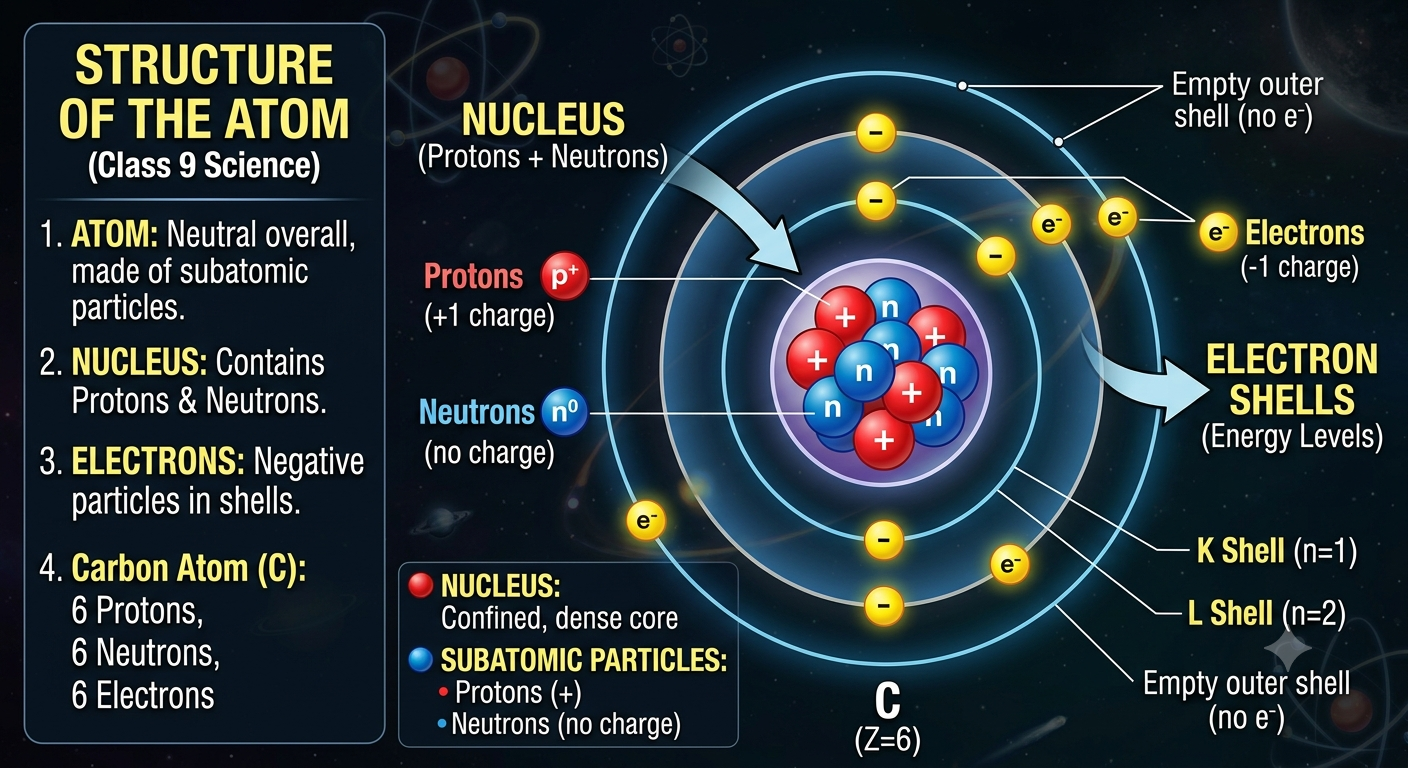
Introduction to Atomic Structure
In the early 19th century, atoms were thought to be indivisible. However, the discovery of sub-atomic particles like electrons and protons revolutionized our understanding. Various scientists proposed models to explain how these particles are arranged within an atom.
Thomson's and Rutherford's Models
J.J. Thomson proposed a model similar to a Christmas pudding, where negative electrons are embedded in a positive sphere. Rutherford's alpha-particle scattering experiment led to the discovery of the tiny, positively charged atomic nucleus, though his model couldn't explain atomic stability.
Bohr's Model of the Atom
Neils Bohr successfully proposed that electrons are distributed in different shells (discrete energy levels) around the nucleus. If these shells are complete, the atom is stable. Later, J. Chadwick discovered neutrons, completing the picture of the three sub-atomic particles: electrons, protons, and neutrons.
Valency and Isotopes
The combining capacity of an atom is its valency, determined by the electrons in its outermost shell. Elements are defined by their atomic number (number of protons). We also see isotopes—atoms of the same element with different mass numbers—and isobars, atoms of different elements with the same mass number.
Discussion 0
Leave a CommentNo comments yet
Be the first to share your thoughts on this story!
Leave a Comment
Join the conversation and share your insights.